

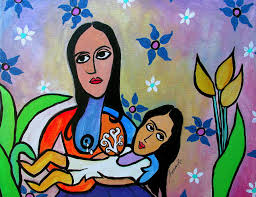
There is a frequent invocation of the mother figure in our politics. We remember the promise of riyasat hogi maan ke jaisi and today we see Maryam Nawaz, Chief Minister of Punjab, presenting herself as the great mother of Punjab. Such gestures strike deep chords in our collective psyche, for they echo childhood memories and cultural myths. Yet, for all their emotional appeal, they are troubling. To invoke the mother in politics is to invite citizens to abandon critical judgment and surrender to affection. It is to turn the governed into children, waiting for unconditional love rather than demanding accountability. Politics becomes domestic drama, not public contract.
This is not an accident. In South Asia, the mother has always been a figure of great power, yet also a source of profound ambivalence. In everyday life we invoke her as a blessing—ye sab maa ki dua hai—or celebrate her protection through the Punjabi saying maawan thandiyan chhawan, mothers as cool shades in a harsh world. But even in these tender words lies a note of unease. As Ashis Nandy reminds us, the Indian fantasy life is shaped by the image of a fickle, incorporative mother, who nourishes but may also engulf, who blesses but can also curse. The Hindu goddesses Durga and Kali embody this duality—at once benevolent protectors and terrifying destroyers. The mother is thus never a simple figure of love. She is a paradox, revered and feared in equal measure, an ambivalent image that makes her use in politics even more fraught.
Against this stands the figure of the father, who carries a different cultural weight. Nandy has provocatively suggested that the state might better be imagined as a “fortunately distant, frequently absent father.” The father in this vision does not smother with love but sets boundaries, creating space for autonomy. Lacan’s psychoanalysis resonates here: the “Name-of-the-Father” introduces law and language, interrupting the child’s overwhelming fusion with the mother. The father is the figure who insists that one must step out of the cocoon of maternal dependence into the world of independence and responsibility.
Nandy goes further. The great emotional investment in the mother in South Asian culture, he argues, is often a compensatory mechanism. Societies profess extraordinary love for mothers because they remain fearful of women’s autonomy. The idealisation of motherhood is a way to keep women confined. By glorifying them as mothers, women are reduced to reproductive duty and caregiving, their subjectivity absorbed into a symbolic role. What looks like reverence is also repression; what sounds like worship is also fear. The mother is placed on a pedestal, but it is a pedestal that denies her freedom. This cultural trap, Nandy suggests, is one of the subtlest strategies of patriarchy: turn the mother into an object of devotion and she will no longer be a full subject in her own right.
It is in this context that Maryam Nawaz’s projection as the mother of Punjab must be seen. It is a move that tries to draw from deep wells of culture and psychology. But it is regressive. Benazir Bhutto, the greatest and finest woman leader we have ever seen, never sought legitimacy through such maternal imagery. Maryam’s turn to motherhood taps into archetypes of love, fear, and dependency that are already too thick in our culture. It does not free women from these archetypes, it reinforces them. It does not enlarge women’s agency, it binds them again to the old roles of nurturer and protector. We have more than enough mother projections already—from the mythical Mata to the countless proverbs that both sanctify and limit women. To add one more in the shape of a political leader is to take us backwards. What is needed is a politics of transformation, freedom, and accountability, not one of maternal affection and filial obedience. The slogan of the great mother of Punjab, at its core, is a regressive strategy, a way of gaining control by wrapping power in the comforting but suffocating embrace of a cultural archetype.