

رانجھݨ اَنگ لگایا
سبھ غیر دا وَہم بھلایا
(When Ranjhan embraced me, all illusion of otherness vanished.)
In the long, undulating tradition of South Asian mystical love poetry, one repeatedly encounters the voice of the feminine lover yearning to lose herself in the beloved’s embrace. This is the voice of Heer calling to Ranjhan, of Sassi to Punnu—the voice that trembles between the human and the divine. Khawaja Ghulam Farid’s couplet—Ranjhan ang lagaya, sabh ghair da wahm bhalaya—belongs unmistakably to this lineage. Traditionally, it has been interpreted within the Sufi metaphysics of wahdat al-wujūd—the union of lover and Beloved, self and God, where all illusions of duality are effaced.
Yet this conventional interpretation, while spiritually alluring, limits the poem’s aesthetic and linguistic vitality. It confines the couplet within a theological vocabulary that presumes a preordained metaphysical resolution. Such a reading, in effect, silences the independent life of language and denies its polysemic potential. Poetry is not the servant of doctrine; it is a system of signifiers that continually produces meanings beyond intention. Once written, a verse like this escapes its devotional cage and enters the open play of language, where meaning arises not from divine correspondence but from the friction of words themselves.
Let us, therefore, approach this couplet not as a report of mystical ecstasy but as a linguistic performance of desire and misrecognition—a text that reveals, in its structure, what Lacan calls the drama of the speaking subject.
In Lacanian psychoanalysis, desire is born of lack; the subject is constituted precisely by what it does not possess. Love, in this grammar, is the fantasy of overcoming that lack—an attempt to become whole by merging with the Other. Yet in loving, one inevitably distorts the other, turning the beloved into the mirror that reflects one’s own incompleteness. “I love you,” Lacan says, “but because I love in you something more than you—the objet petit a—I mutilate you.”
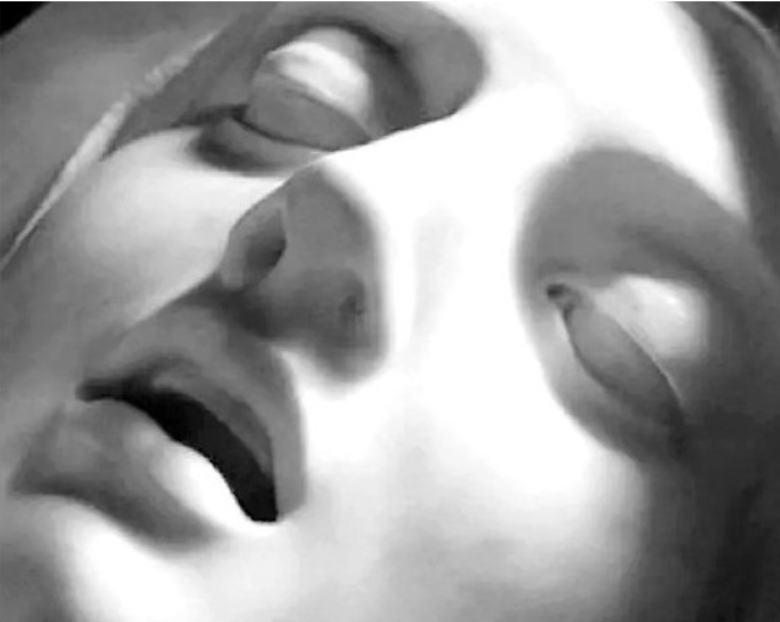
In Farid’s couplet, the I that speaks is not the commanding voice of the mystic knower but the vulnerable, desiring voice of Heer—the feminine subject whose being is suspended between speech and surrender. “Ranjhan embraced me”—the line begins with the Other’s action, the masculine subject’s agency, and the feminine subject’s receptive body. Yet it is Heer who speaks; it is she who names and thereby reclaims the experience. The embrace becomes the scene where her desire meets its own reflection.
The next phrase—“all illusion of otherness vanished”—appears to promise completion, the final closing of lack. But within a Lacanian frame, this very disappearance of “ghair,” the Other, is suspect. It is not divine reconciliation; it is the Imaginary fantasy of fusion where difference collapses. In that instant of ang lagaya—that tactile moment—the feminine subject enters what Lacan calls jouissance féminine: an excess of pleasure that transcends the phallic logic of possession and mastery.
Feminine desire, for Lacan, is not defined by what it lacks, but by its openness to the Other, by its being “not-all” (pas-toute)—not contained within the Symbolic order that structures masculine desire. Heer’s utterance embodies precisely this not-all: it gestures toward a fullness that cannot be symbolized, an enjoyment that eludes representation. In the embrace, she reaches the threshold of the Real, where words tremble and meaning dissolves. Yet this jouissance, by its very nature, cannot endure. To name it is to lose it. The second clause—sabh ghair da wahm bhalaya—returns the subject to language, to the symbolic field where difference reasserts itself. What was an unspoken intensity becomes a spoken loss.
Thus, Farid’s couplet dramatizes not mystical union but the perpetual oscillation between desire and its impossibility. The embrace signifies both the momentary collapse of boundaries and their inevitable restoration. The poem’s syntax mirrors this movement: the ellipsis between the two phrases marks the instant of unspeakable contact, followed by the fall back into the articulable world of “wahm”—illusion, imagination, signification.
In this light, Farid’s lines become a subtle theatre of feminine subjectivity. The woman’s voice, long interpreted as the voice of spiritual submission, reveals itself instead as the locus of complex desire—desire that knows its own limits, that touches the Real only to retreat into the safety of language. The poem speaks of the impossibility of total union, and yet celebrates the beauty of that impossibility.
Farid’s Heer, then, is not merely the mystic soul longing for God; she is the speaking subject of desire, standing at the edge of the unsayable. Her words shimmer with the knowledge that love fulfils only by failing, that every embrace conceals the persistence of otherness, and that poetry itself is born from this luminous failure—the endless, tender attempt to name what cannot be held.