

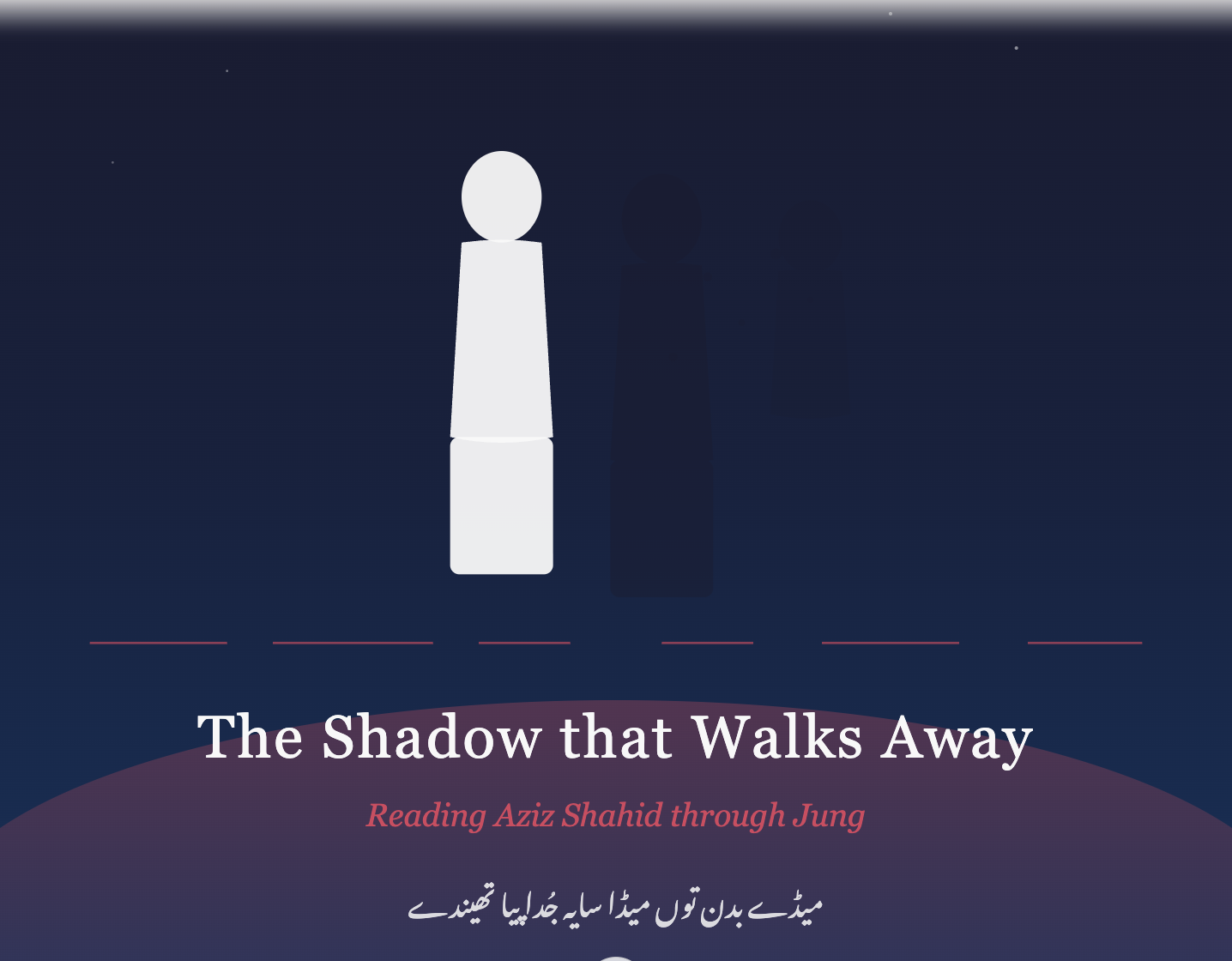
The Siraiki poet Aziz Shahid writes in a couplet:
میݙے بدن توں میݙا سایہ جدا پیا تھیندے
ݙس ڑی نُتھی نماشاں آخر اے کیا پیا تھیندے
My shadow keeps separating from my body Tell me, O incomplete twilight — what is finally becoming of all this?
At first reading, it appears to be a simple lament about alienation. But a closer look reveals something more unsettling. The poet is not merely sad. He is watching a part of himself drift away — and he does not know what this drifting means.
To understand this properly, we need to approach the concept of shadow as Swiss psychologist Carl Jung understood it.
For Jung, the shadow is not the dark outline that follows our body in sunlight. It is a psychological reality. The shadow, in Jungian terms, refers to those parts of our personality that we have pushed into the unconscious. These include desires we find shameful, instincts we have been taught to suppress, and aspects of ourselves that do not fit the image we want to project to the world.
The shadow is not evil by nature. It is simply that which we refuse to see. A person who prides himself on being calm may have pushed his anger into the shadow. Someone who appears excessively modest may have buried her ambition there. The shadow holds what we deny.
Jung insisted that the shadow does not disappear simply because we ignore it. It remains with us, following us like a literal shadow follows the body. More importantly, Jung argued that psychological health — what he called individuation — requires us to integrate the shadow. We must acknowledge what we have denied. Only then can we become whole.
Now, let us return to Aziz Shahid.
When he says that his shadow is separating from his body, he is describing the opposite of integration. Something that should remain connected is drifting away. This is not a natural process. In the Jungian framework, this separation signals a crisis of the self.
What happens when the shadow separates? The person loses access to a part of himself. He becomes incomplete, even if he does not fully understand what is missing. He may feel hollow, fragmented, or confused about his own identity. The denied parts of the self, instead of being integrated, have now become so alienated that they no longer feel like they belong to him at all.
This is precisely the condition the poet describes. He is watching himself become less than whole.
The second line deepens this crisis. The poet turns to the twilight and asks it: tell me, what is finally becoming of all this?
Why does he address the twilight? Because twilight is the in-between time. It is neither day nor night. In Jungian terms, we can think of daylight as consciousness — the rational, aware, socially acceptable self. Night represents the unconscious — the hidden, instinctual, shadow realm. Twilight, then, is the threshold between the two.
Jung emphasised that the process of becoming whole requires crossing this threshold. One must enter the twilight zone, so to speak, and confront what lies in the darkness. Only by making this journey can one integrate the shadow and achieve individuation.
But in Aziz Shahid’s couplet, the twilight itself is نُتھی — incomplete, broken, not whole. The threshold is damaged. The bridge between conscious and unconscious is fractured.
This is a devastating image. The poet cannot integrate his shadow because the very passage that would allow integration has collapsed. He is stuck. His shadow drifts away, and he has no means to retrieve it.
The final poignancy lies in the question itself. The poet asks the incomplete twilight: what is becoming of me?
He asks a broken thing to explain his brokenness. He seeks answers from something equally fragmented. This is not hope. This is the recognition that no answer may come.
Jung would perhaps say that this is the dark night of the soul — a phrase borrowed from the mystics but useful here. It is the moment when the self confronts its own disintegration and finds no ready path to wholeness.
Aziz Shahid’s couplet, read through Jung, becomes a precise diagnosis of a psychological condition. The shadow separates. The threshold breaks. The self fragments. And the poet, standing in this ruin, asks a question that may have no answer.
2 responses to “The Shadow that Walks Away: Reading Aziz Shahid through Jung- Mushtaq Gaadi”
One of the exploding interpretation of the incomplete self.
I think it needs revision. Humble suggestion