

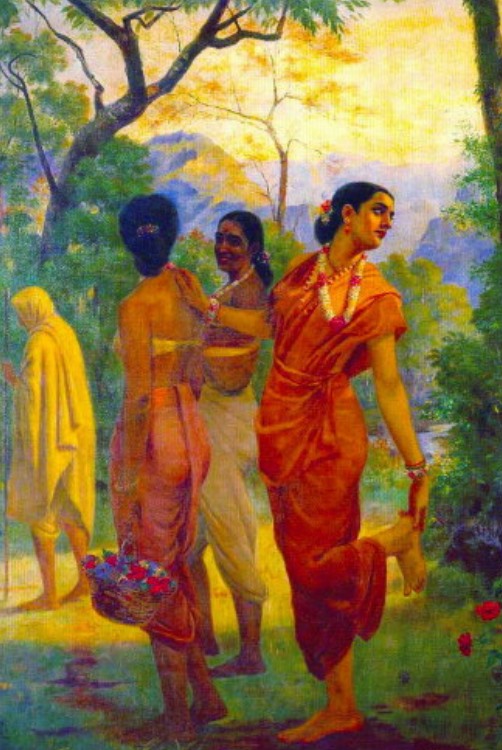
چمتکار چِت وِستار روپ
(وِشواناتھ کوی راج ، سہیتیا دَرپن)
Some scholars say that the ancient art theories of Sindh–Hind (the Indic world) emerged from ideas connected with food and the kitchen. The word chamatkār is especially important here. Raghavan says that the word cham is linked to the tasting and enjoyment of rich food. From this root comes the feeling produced by delicious cooking—a sudden delight, an involuntary appreciation, a spontaneous “wah!”. In modern usage, this word connects well with the English meanings of wonder, surprise, and magic.
When art and consciousness come together, this sense of wonder gives rise to admiration. The beauty and chamatkār of art break down the rigid walls of the ego that surround the self. Through art, the human mind is momentarily absorbed in the play between “being” and “non-being”. Art awakens the unconscious and makes it conscious. As the 15th-century Telugu poet-scholar Vishwanath Kaviraj puts it, “The chamatkār of art is the expansion and deepening of our consciousness.” It gives rise to new forms of awareness.
Indic art theories explain that this chamatkār of art reaches us through rasa. Rasa itself is a word connected with food. Just as the essence of a thing is hidden in its taste, the vitality of art lies in the play of rasa.
In the Nāṭya Śāstra, Bharata Muni identifies eight fundamental rasas present in all forms of art:
- Śṛṅgāra (love, desire)
- Hāsya (laughter, humour)
- Raudra (anger)
- Bībhatsa (disgust)
- Bhayānaka (fear, terror)
- Vīra (bravery, heroism)
- Adbhuta (wonder, marvel)
Each of these rasas represents a particular mood or state of consciousness.
All these rasas reach the human mind through bhāvanā, which is closely tied to various emotional states (bhāvas). For example, in stories or plays about Radha and Krishna, the śṛṅgāra rasa appears in the form of gopī-bhāva. This rasa of love is never singular; it is made up of a rich mixture of emotions—separation, longing, union, desire. Similarly, in Krishna’s Rās Līlā, the transformation of the moonlit night, the forest, the flute, and the gopīs into an enchanted world is an expression of adbhuta rasa, the rasa of the magical and marvellous. For devotees, dissolving into gopī-bhāva is the very essence of devotion. In the Rāmāyaṇa, Rama’s heroism (vīra rasa) forms the dominant emotional core of the narrative.
Without bhāvanā, there can be no art and no rasa. To understand this, we must look at the word itself. The root of bhāvanā is bha. In Proto–Indo-European linguistic studies, this sound carries three core meanings:
(i) shining or glowing,
(ii) coming into being,
(iii) calling forth or evoking.
In Sanskrit, this root combines with many sounds to produce a long family of words: bhāṣā (language), bhāvanā (feeling/imagination), bhāvanī, bhūta (being), adbhuta (wonder), bhāgya (fortune), bhagavān (the divine), bhakti (devotion), bhoga (enjoyment), bhojana (food), bhajan, and many others. If we look at other Indo-European languages, we find similar roots in ancient Greek—phōnē, phēmē, physis—which later give us English words like phone, phantom, and fantasy. All these arise from the same sound-root bha and its associated meanings.
Indic aesthetic thought shows that whether it is language, emotion, or fantasy, art—through poetry, painting, music, storytelling, and theatre—turns non-being into being through chamatkār. In the play of rasa, bhāvanā acts as a form of imagination where the opposition between real and unreal dissolves.
This question of the relationship between art and reality is what distinguishes Indic art theory from simplistic notions such as magical realism, which often remains trapped in an oxymoron and turns fantasy into an objectified technique. It is within this deeper understanding that we can also begin to open up many layers of Indian art and its theatrical adaptations.
To truly grasp this, we must once again return to Bharata Muni’s Nāṭya Śāstra and to thinkers such as Bhoja, Śrī Śaṅkuka, Bhaṭṭa Nāyaka, Ānandavardhana, Abhinavagupta, and Vishwanath Kaviraj.