

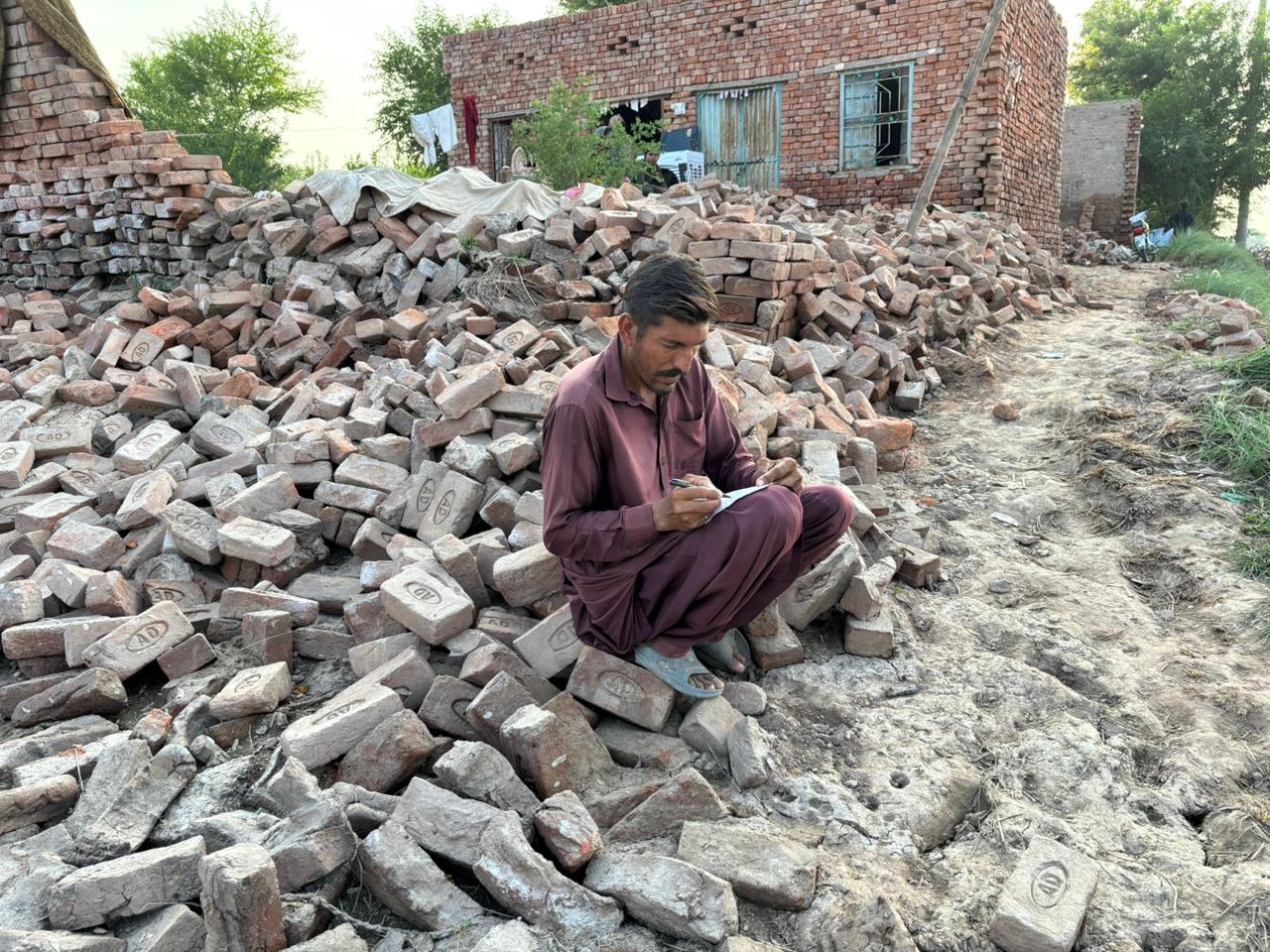
This is Baqir Hussain, a Saraiki poet from Sher Shah, whose home was claimed by the raging floods of the Chenab. I first went with him a month ago when he rescued his family. Later, when the grief of losing his books was too heavy for him to voice, I asked if we should return—and together we salvaged the fragments of his life’s work. He smiled through his tears holding those books, as if saving his words might still anchor a future.
Today he sits in the ruins of that house. Its washroom has vanished, its four walls collapsed, its roof just one more rain away from falling onto his sleeping children and mother. He tells me he does not have the money to rebuild. He has no access to relief packages because his home lies too far from the road. He is depressed, abandoned, yet still waiting for the state to even acknowledge his loss.
But Baqir is not alone. Nasreen Bibi, a widow with five children, pulled me by the arm and pleaded, “Please listen to me, this is my home. My walls are gone, and these rooms are unfit for living. I only have a charpoy where my children can sleep. How can I earn money for this destruction if I must leave them here?” Her eyes were swollen with tears, yet her voice carried the strength of someone who refused to be silent. She wanted the world to know that their lives are torn apart.
The people here speak openly of despair, but also of betrayal. Some accuse political infighting at the local level of paralyzing relief. Others say that because they did not vote for the current representative, his team refuses to provide them with rations. Still others claim that Patwaris openly demand bribes just to list their names for government aid. What should have been unconditional relief is turned into a market of patronage and extortion.
They tell me what they need is not charity handed through party workers, but a comprehensive, direct people-to-government programme—like the Benazir Income Support Programme, once was. Yet BISP has withered here, leaving women in villages waiting endlessly, stuck in lines for cheques, that has yet to arrive , blocked at every stage by bureaucratic gatekeepers until they reach the Assistant Commissioner or Deputy Commissioner. In many areas, even mobile signals are absent, severing the last threads that connect them to the state.
Government of Punjab may boast that Punjab is prospering, that development marches forward. But in Sher Shah and across South Punjab, two hundred thousand families live in ruins—proof that “progress” is only built for the center, not the ‘periphery’. The floods may have been natural, but the suffering is entirely political: a system that treats Saraiki peasants as expendable, left to rot in bureaucratic queues while Lahore’s roads are carpeted in asphalt.
What I saw is not disaster relief—it is disaster governance. It is a political economy that converts human suffering into leverage, aid into patronage, and citizenship into dependence. This is not the failure of a single government; it is the logic of a state built to serve capital and control, not people.
I am just a journalist. I cannot rebuild Baqir’s home, nor can I give Nasreen’s children a roof. But I can testify: their abandonment is deliberate, their pain weaponized by neglect. If you want to see the so-called progress, the Punjab government claims it is making, don’t look at Metro buses or underpasses in Lahore. Come stand in the ruins of Sher Shah, Jalalpur, Alipur, and Seetpur. Listen to Baqir’s clutching his poetry. Listen to Nasreen’s plea for dignity. Then you will know the truth: “all is well” is the cruelest lie of all.