

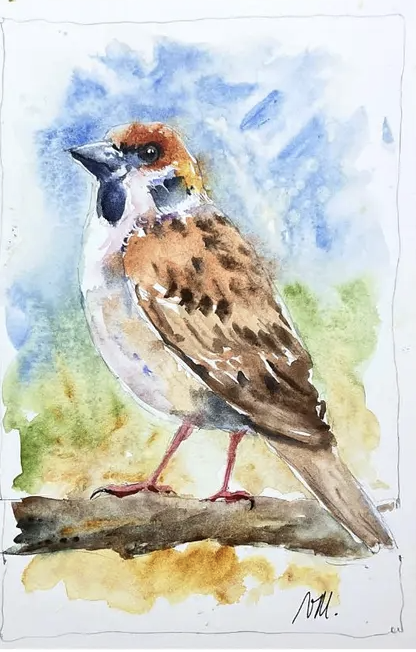
سب مایا
شام تھئ وت بیرِیں اُتے
چڑیاں دے پُھل لگے
ریتاں دی درسال دے اگو
عمراں دی نیں وگے
شام تھئ وت بیڑی دے وچ
اکھیں سجھ وسمایا
کندھیاں خالی ، پتݨ خالی
جنگل رڃ کُرلایا
سب مایا ، سب مایا
اشو لعل
Sometimes, the most powerful poetry is the one that whispers, not the one that explains.In Sab Maya, evening is the first whisper of illusion.It is the hour when truth begins to flicker and beauty begins to ache. Evening here, is far more than a time of day. It is a metaphysical threshold, a poetic condition and a civilizational metaphor. It marks the moment when light begins to fade not just in the sky but in the meaning and in certainty. Evening is the hinge between presence and absence, between what once was luminous but now dissolved into shadow.In both stanzas evening initiates defamiliarization and transformation. Sparrows become flowers and eyes extinguish the sun. Evening is the ritual hour of mourning when Ashu, as heir to vanished world confronts the ache of memory and the silence of meaning.It is the moment when world ceases to be what it was and becomes what it can not fully name.It marks the moment when light recedes and form begins to blur.The ritual hour of mourning when prayers are whispered, lamps are lit and memory awakens.When veils between visible and invisible thins and illusion becomes visible. Evening initiates ontological transformation. Sparrows do not remains sparrows, they become flowers.This is not metaphor in decorative sense.It is defamiliarization as metaphysical act.The sparrows are not compared to flowers, they become flowers.They are estranged from their category and reclassified by twilight.Dusk does not merely change light, it reconfigures reality.
Why flowers?
Because flowers are ephimeral, delicate and ritualistic.They bloom and fade.They are offered in mourning and celebration.By turning sparrows into flowers, Ashu transforms a mundane image into symbol of transience and nostalgia.The birds once noisy and restless, are now blooming silently, like offerings to the fading day or faded civilization. Ashu captured a local, familiar scene, sparrows gathering noisily on a jujube tree at dusk not to transform it just into a vision of ephimeral beauty.This defamiliarization and transformation tells us that perception is unstable, that beauty often arises in the moment of dissolution. Evening becomes a semantic atmosphere in which defamiliarization is possible.
“Semantic atmosphere” was a term coined by my late teacher, Professor Samuel Lal Deen. One day, during a lecture, he said:
“Evening and wine together create such a semantic atmosphere that I begin to match words with faces, in it”. So when sparrows become flowers at dusk, it is not a trick of language, this is the outcome of rare transformation.It is a gesture of mourning, a civilizational sigh. Flowers of sparrows are an offering to the fading day, faded civilization.The second couplet of first stanza shifts from tree to terrain.The threshold of sand evokes the dessert’s edge, a place of erosion and transition.The torrent of our lifetimes flowing beyond it suggests that our lives are transient currents slipping past the edge of sand, sand which is again a perpetual farewell to form. The entire imagery becomes a meditation on impermanence.The sparrows bloom and vanish, the torrent flows and disappears.The tree, the sparrows, the sand and torrent, all are part of a cosmic illusion, a fleeting spectacle of form and sound.
The second stanza deepens the mood of Sab Maya, shifting from the blooming sparrows of dusk to a more interior melancholic landscape. Each line is a portal into solitude and emptiness, memory and metaphysical ache.”Eyes extinguished the sun” implies that an entire world view, a cultural light, a system of meaning has been extinguished.Not just within the self, but across the time.So the sun, here, is not a celestial body.”Eyes extinguished the sun” beautifully captures the mourning of meaning, the loss of permanence and transience of cultural memory.
Which eyes? Whose eyes?
The eyes extinguishing the sun are no longer just personal.They are ancestral and historical.Eyes are historical agents, they witnessed, remembered, shared and finally closed with the dying sun.The absence of all the cases of personal pronoun in Sab Maya is not a stylistic omission.It is poetic decision that reinforces the poem’s depth.The eyes that extinguished the sun are not placed in a singular self, they are ancestral.They are the eyes of those who witnessed the rise and fall of the civilization.By avoiding the use of my or our, Ashu allows the voice to become collective, timeless and unclaimed.This pronoun free architecture turns the poem into a vessel of shared memory. In this way Sab Maya becomes not just a poem but a chorus of silences where history, illusion and longing speak through absence.The grief is not personal, it is inherited. And it successfully draws the geography of grief.In this geography the mourning is not subjective, it is civilizational.It is as if Ashu carries a memory of vanished world, forgotten rituals and unspoken farewells.
کندھیاں خالی ، پتݨ خالی
جنگل رڃ کُرلایا
سب مایا ، سب مایا
Both the shore and landing are described as empty.In civilizational frame work they represent the threshold of meaning. The places where arrivals and departures once occurred, where trade, rituals, philosophy or meaning once touched the land.Their emptiness signals that traffic of meaning has ceased. The deserted Pattan marks the absence of arrival and impossibility of return. What was once connected, now stands as a relic. The forest cries deep and long. The forest’s cry is civilizational grief, the sorrow of knowing that even the most luminous truths disslove.Here the forest becomes repository of memory.It is history mourning itself.”In the absence of human speech, history becomes the last mourner, the one who remembers when all others have forgotten”(anonymous).
The refrain, “All is illusion” is not a conclusion. It is a revelation. It arrives not as doctrine but as an experience, lived, seen, felt in the form of language and landscape.The poem does not argue, it enacts “All is illusion”.