

What happened to Sheetal—also reported as Banoo—in Balochistan is being hurriedly filed under the usual headline: “honour killing.” A viral video showed a young couple taken in pickup trucks into a desert clearing, the woman handed a Qur’an, telling her companion, “Come walk seven steps with me, after that you can shoot me,” and then calmly facing the gun. Provincial authorities say the pair had married without family consent; a local tribal council allegedly ordered their execution. The Balochistan chief minister announced arrests; an FIR has been registered and terrorism sections invoked after the video triggered national outrage. Yet even as arrests are made, the interpretive closure—this is what Baloch tribes do—locks in. We should resist that reflex. The evidence from Upper Sindh and adjoining Baloch areas that Nafisa Shah painstakingly assembled shows that what now passes as “customary honour killing” is in significant measure a legal artifact—first shaped by British codifications that folded fluid norms into the colonial Penal Code and frontier regulations, then re-tooled by post-colonial Islamisation that privatized prosecution through qiṣās and diyāt. Sheetal’s death belongs to this modern legal genealogy, not to some timeless Baloch essence.
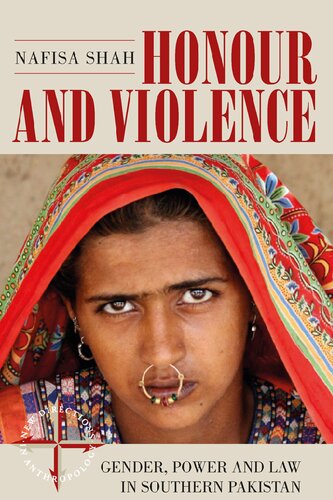
Shah’s research in Honour and Violence: Gender, Power and Law in Southern Pakistan begins from the blunt proposition that “law” and “custom” in Upper Sindh are co-produced; you cannot peel one away to reveal an untouched tribal core. In interviews about the book she stresses that her subject—karo-kari—must be read within “modernity and a modern post-colonial state” that creates spaces in which “customary practices reinvent themselves.” In other words, the state does not just regulate honour violence; it makes it legible and actionable, stabilising categories (who is blackened, what counts as provocation, who may forgive) that circulate back into social life.
Colonial codification was the decisive first move. The Indian Penal Code’s Exception for “grave and sudden provocation”—imported from metropolitan jurisprudence and filtered through administrators eager to appease male honour on the frontier—regularised leniency for men who killed over alleged adultery. Rights groups chronicling the genealogy of honour crimes in Sindh have long noted that British courts and district officers treated such killings as mitigated homicides when routed through the provocation clause; this juridical indulgence fed local expectations that sexual suspicion could be cleansed in blood with reduced penalty.
When Pakistan Islamised its criminal law, it did not dismantle the colonial scaffolding; it re-inscribed it. Under General Zia-ul-Haq’s Islamisation drive, qiṣās and diyāt doctrines were introduced (the process formally commencing in 1990 in the wake of Federation of Pakistan v. Gul Hassan), recasting homicide as a private wrong whose resolution lies with the victim’s walī—normally the heirs. Critics immediately warned that when relatives are also perpetrators or complicit, they can waive retribution or accept compensation, effectively neutralising the state’s capacity to punish “honour” murders. Feminist legal analyses show how these provisions have repeatedly enabled killers to walk free; field reports from women’s rights organisations underline that jirga-ordered killings can be laundered through familial pardons.
The persistence of impunity is not theoretical. Human-rights monitors, journalists, and even government spokespeople concede that the clause allowing relatives to pardon the killer—only partially curtailed by 2016 reforms—still lets many offenders escape serious punishment. International coverage of Sheetal’s case quickly flagged this systemic flaw; Balochistan officials themselves moved to lodge a state FIR and add terrorism counts precisely because affected families had not filed complaints, a tacit admission that leaving prosecution to kin collapses when honour is collectivised.
Labeling Sheetal’s murder “Baloch custom” therefore misrecognises both the crime and Baloch culture. It mistakes a phenomenon incentivised by state law for an aboriginal code and erases internal dissent, plural practices, and histories of tolerance around gender and love. Shah’s work documents how karo-kari accusations are strategically mobilised—cover for domestic violence, land disputes, or debt extraction—precisely because the law creates bargaining space; calling that “tradition” naturalises what is often calculated, instrumental violence.
Consider, too, the counter-memory carried in Baloch poetry. The nineteenth-century Sufi-lover Mast Tawakkali Marri publicly adored Samo, a married woman and mother; tribal elders debated, tested, even threatened him—but did not kill either lover. The story, retold across Balochistan, ends not in blood but in canonisation: Tawakkali’s ecstatic verse turned human eros into a path toward the Divine, and communities that might have claimed dishonour instead enshrined his name. Contemporary accounts emphasise that Samo’s husband and tribesmen, after witnessing Tawakkali’s devotion, refrained from lethal reprisal; the poet wandered, sang, and was revered. That cultural memory undercuts the lazy syllogism that female sexual transgression in Baloch society and culture is inevitably and eternally linked with the sanction of death.”
Sheetal, defying death for the right to love, becomes the living echo of Mast Tawakkali’s verses to Samo—the same fierce, forbidden tenderness now written in her own blood. Listen to Mast Tawakkali.
چو سوھرݨ انار ءُ ر بہگاءِ گلاب ءِ پیما انت سمو / چو شیشگ ءِ شہرا̄ب ءِ پیما انت سمو
Translation
Like a crimson pomegranate bursting with sweetness,
like a rose‑garden heavy with perfume is Samo;
and like a crystal goblet brimming with ruby wine,
so intoxicating is Samo.