

طلب جنگل دی بھا ہے
بھا لڳس، چو پھیر لڳدی ہے
“Desire is the wildfire of the forest—
and damn it, once it ignites, it spreads all around.”
Aziz Shahid, one of the most distinctive Siraiki voices of our times, repeatedly returns to the question of desire. In poem after poem, desire erupts in images of fire, wilderness, wandering dust, butterflies, mirrors and spectacles. Shahid does not merely use desire as a poetic ornament; he interrogates it, chases it, complains to it, and sometimes even curses it. His poetry is saturated with a restless enquiry: What is desire, and how does it move within us? This obsessive concern, I would argue, occupies a position strikingly close to what psychoanalysis calls the hysteric’s discourse.
In his poetry, we encounter a foundational statement on desire:
طلب تماشے عجیب ہوندن
نہ سُرت ݙیندن
نہ بُرت ݙیندن
“The spectacles of desire are strange—
they give no understanding,
no sign or direction.”
This couplet announces the terrain Shahid will inhabit: desire appears as a spectacle staged before the subject, a show that promises meaning yet withholds it. It dazzles the eyes but denies comprehension. It pulls one forward but refuses direction. In Lacanian terms, this is precisely the structure of hysterical desire—a desire that demands interpretation from the Other, yet rejects every interpretation; a desire that must remain unsatisfied to remain alive.
Shahid’s metaphors confirm this. In one verse, he writes:
ہُݨ تاں ہک بے انت طلب دا
تھل اے پیریں تلّے
“Now beneath my feet lies an endless desert of desire.”
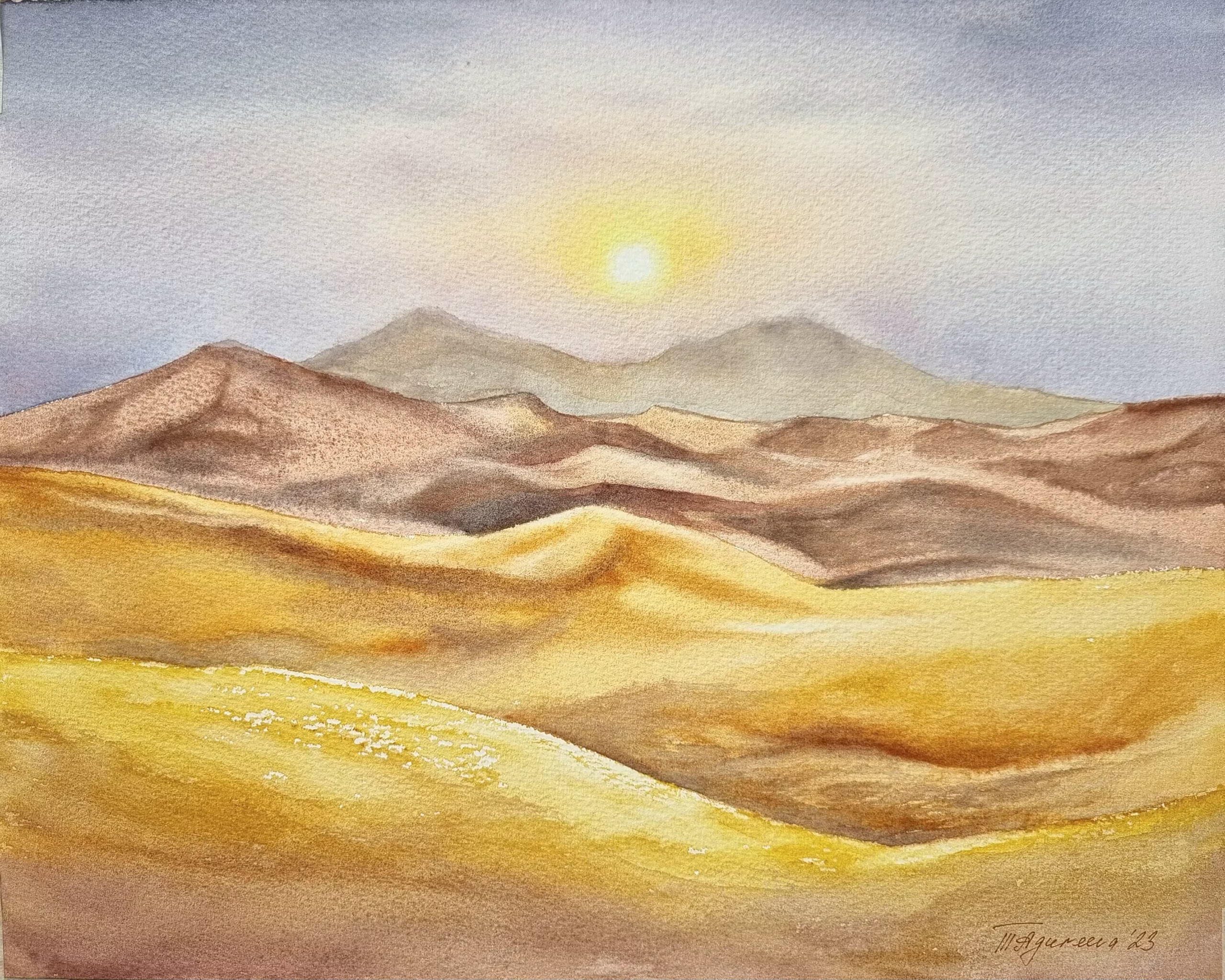
Desire, here, is not a momentary longing but a boundless terrain one stands upon. The poet finds no solid ground, no resting point. The desert expands infinitely, mirroring Lacan’s claim that desire is structured by lack—it has no final object, no terminus, no home.
In another striking image:
کوئی اندھی طلب ہئی
تتلیاں دے پر سجا کے، رنگ پا کے وت اݙر پئی اے
“There was a blind desire—
decked in butterflies’ wings and colours, it flew off again.”
Here desire appears blind, directionless, masking itself in borrowed colours, only to escape once more. This is desire in its metonymic motion, sliding from signifier to signifier, changing form, fleeing grasp. Nothing could be more hysterical in structure: the subject chases desire, desire disguises itself, and in the chase itself desire is preserved.
To understand why Shahid’s poetic stance resembles the hysterical position, one must recall Lacan’s insight:
The hysteric is the one who asks: “What is desire?”
Not for satisfaction but for meaning. Yet desire, by its very nature, denies meaning. This very denial keeps the hysteric’s desire alive. Poetry, too, thrives on such denial. It does not aim to conclude but to keep open; it does not settle desire but circulates desire.
Shahid repeatedly stages this circulation. Consider:
طلب تاں میݙی جان بے انت تھل اے
طلب دا کتھئیں وی ٹکاݨا نہ تھیوے”
“Desire is an endless wasteland;
desire settles nowhere—nowhere is its place.”
Desire becomes a groundless expanse, a space without orientation. In psychoanalysis, desire’s refusal to settle is not a flaw but its essential feature. The hysteric sustains desire by remaining dissatisfied; poetry sustains desire by refusing closure. Shahid’s verses show both movements intertwined.
At moments Shahid even positions himself genealogically within desire. In one his Urdu poem, he writes:
میں ریگِ صحرا، میں ایک صحرا نورد ذرّہ
یہ میرا شجرہ، مرا نسب ہے تری طلب ہے
“I am desert sand, a wandering grain in the wilderness.
This is my lineage, my ancestry: your desire.”
This is an unmistakably Lacanian formulation: desire of the Other is the origin of the subject. Shahid’s “lineage” does not come from family or soil but from the beloved’s desire. The poet becomes both the lover and the analyst, tracing his being to the Other’s desire while attempting to articulate the mystery of that very desire.
His poetry also dramatizes desire as spectacle:
طلب تماشے بݨا ݙتے ہِن
چودھار شیشے سجا ݙتے ہن
ذرا تاں نیناں کوں کھول …… کیا ہے؟”
“Desire has arranged its spectacles,
mirrors glitter on all four sides.
Open your eyes a little—what is this scene?”
Here desire transforms the world into a hall of mirrors—reflections without centre, images without a fixed truth. This is precisely how desire appears in Lacanian hysteria: multiplied, refracted, elusive, reflecting back the subject’s own lack.
But there are moments when Shahid’s poetry moves beyond the hysterical structure. When imagery shifts from symbolic spectacle to embodied intensity, the poem touches what Lacan calls Other jouissance—an experience beyond meaning, beyond the symbolic, beyond speech.
This movement becomes unmistakable in the following verse:
تیݙی تانگھ طلب دی تاݨی تے
تیݙی مونجھ ولا وُݨ ݙیکھوں ہا
تیݙے لَمس لباں توں لہندے ہوئے
پُھل سرمی دے چُݨ ݙیکھوں ہا
“At the loom of your desire and longing,
I longed to watch your yearning being woven into thread
As the touch of your lips descended,
I wished to gather the yellow flowers of surmi.”
Here desire is no longer a metaphor or a question. It becomes tactile: woven, descending, blooming. The poet does not describe longing; he weaves it. Meaning is overtaken by sensation. Language does not capture desire; it melts before it. This is precisely the terrain of jouissance, where experience exceeds the symbolic and spills into a domain of intensity that cannot be fully articulated.
The poem does not ask what desire is; it enacts desire’s overflow. It is in this register that blind desires repeatedly push his poetry into this zone.