

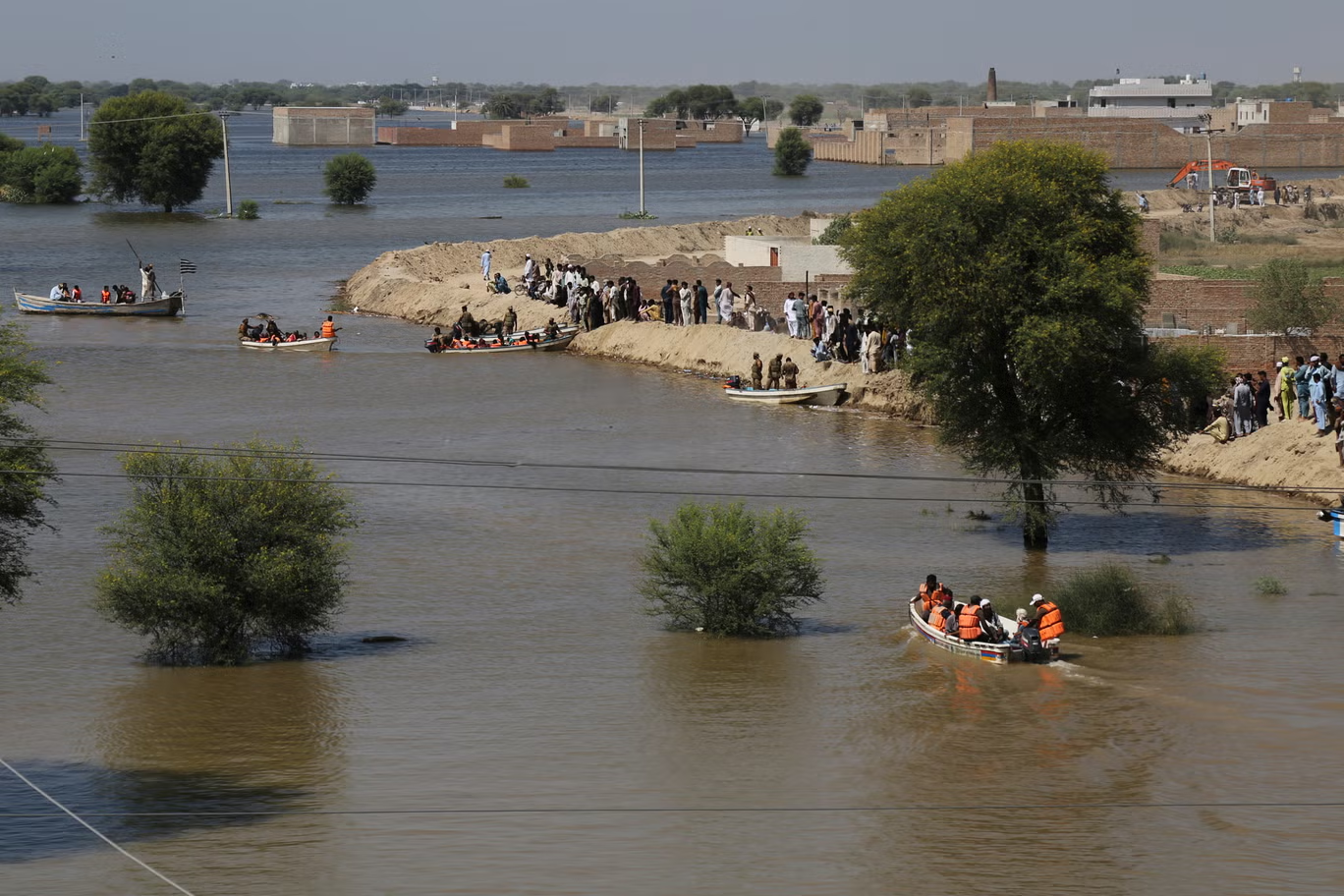
Jalalpur Pirwala, a tehsil of Multan, sits in a perilous geography: the Chenab surges from the west, the Sutlej rises from the south, while the Motorway and Uch Highway slice across natural drainage channels. Downstream, the Panjnad Barrage acts as a choke point, raising riverbeds with decades of silt. Instead of letting floods disperse, these layers of concrete and embankments have turned Jalalpur into a basin where water stagnates and people suffocate.
As thousands remain stranded on rooftops and fields are underwater, the government’s response, as well as that of the media and relevant departments, has been inadequate. Journalist Jowdut Syed, reporting from the ground, describes the catastrophe and its deeper causes.
Q: Tell us about the current situation in Jalalpur Pirwala.
Jowdut Syed: It is catastrophic. State institutions—PDMA, NDMA, district authorities, even the army—together had only 40–70 boats when the floods hit. That’s nowhere near enough for a tehsil of over 600,000 people.
Villages have been completely drowned. On the Chenab side, Basti Jafar, Basti Arain, Shiri Miani—more than 24,000 people—were inundated first. Then Moza Langar, Shini Janwai, Kotla Shah Rasul and others—about 7,000 people—were hit. Later, Moza Shujatpur, Sawan, Basti Langar—another 12,000—were drowned.
On the Sutlej side, Moza Mothra, Basti Miani, Joya Abad, Basti Baloch, Basti Jhulan, Pull Jhangra, Moza Kuch—all badly devastated.
Before this crisis, Jalalpur administration had only 100 life jackets. Imagine: even if half the population is affected—300,000 people—how can 100 life jackets save them? Now they have around 2,000, and today (September 9) the Chief Minister sent 2,500 tents. But where will they be installed? The only feasible spot is the M-5 Interchange, three kilometers away from the city.
Right now, the Chenab is at a level higher than Jalalpur itself. If it rises one more foot, the city of 114,000 will drown. People are building embankments with their own hands, others just sit waiting for rescue. Rescue 1122 is overwhelmed. The Navy and Army are here—but without enough number of boats, what can they do?
It feels like doomsday. Families are stranded on rooftops, crying for food and water. NGOs are trying, but it is ultimately the state’s constitutional duty to protect life. The right to life is in grave danger.
Q: How many villages have been affected?
Jowdut Syed: Out of 114 villages in Jalalpur, more than 75 are fully submerged. And the waters are now at Jalalpur city’s doors. This is a major humanitarian disaster. Mass displacement has begun, and worse is coming.
Q: Authorities and some media suggest people don’t want to evacuate. What’s your observation?
Jowdut Syed: That’s false. A few days back, in Multan, we only saw men in the family staying back to take care of livestock – a valued possession. But they wanted their families to be evacuated. Here in Jalalpur, the situation is entirely different; people are desperate to leave. They can’t, because there are no boats, no resources. The narrative that they’re “refusing evacuation” shifts blame away from the administration’s failure.
Q: You’ve said the scale of flooding is underreported. How so?
Jowdut Syed: Even the DG PDMA Punjab, in a press conferenc,e admitted they don’t have gauges here to measure river flow. He said there could be far more water than reported.
Experts told me the Akbar Band in Muzaffargarh holds up to 875,000 cusecs, and it was full in the initial surge. That’s massive. In Jalalpur, with its low terrain, the water just ponds. On the Sutlej too, at Head Islam, actual flows are much higher than what the Flood Forecast Division shows.
This means Jalalpur’s situation is deteriorating faster than anyone is officially admitting. People have been telling me: “At least let us bury our dead.” For four days, people have been dying. But no official death toll exists. PDMA itself admitted bodies are being recovered.
Meanwhile, national media is absent. International outlets like Al Jazeera and TRT reported, but local channels are silent. Just in Multan division, over 400,000 people are displaced.
And now boats are a business—private owners charge Rs. 1,500–2,000 per person to evacuate. Imagine the poor having to pay to save their lives.
Q: How has this personally affected you as a reporter?
Jowdut Syed: It’s been traumatic. You cannot capture this misery in headlines. People surround us, pleading: “Tell our story.” They want nothing more than to live.
Jalalpur is right by the Motorway, not some far-off valley. Yet it feels abandoned. The MNA here is a federal minister, but he is invisible. People are disappointed and angry.
The district administration is itself shocked. They weren’t prepared. Instead of urgent action, the government will wait until waters recede, then compile reports, then seek funds—which will hardly reach the poor.
This is not only about climate change. It’s also about reckless infrastructure and flawed planning.
Q: Who else is helping besides the government? Any civil society organizations?
Jowdut Syed: Only a few religious groups, like Al Khidmat. Others aren’t allowed. But that’s not the real issue. The real issue is resources. How many boats are there in all of Multan division?
And this is only the beginning. Soon there will be food shortages, sanitation crises, health emergencies for women and children. Technical breaches that should have been made at certain points weren’t made this time. The water was allowed to build up until disaster struck.
Q: Why are breaches not being made where needed?
Jowdut Syed: To protect highways and private infrastructure. At Head Muhammad Wala, the Chenab’s natural width is 8 kilometers, but the bridge narrowed it to 1 km. In floods, water needs space. Without breaches, the pressure rises, threatening thousands.
People believe breaches aren’t being made to protect highways, hotels, and businesses. Look at Sher Shah: no breaches there either. So one side drowns while, across the water, parties go on in hotels.
The tragedy of Jalalpur Pirwala is not simply a natural flood. It is the consequence of geography made worse by decades of neglect. Panjnad Barrage has raised riverbeds with silt, highways have blocked natural drainage, and private embankments divert floods onto the poor. Instead of giving rivers room to breathe, concrete and politics have turned Jalalpur into a prison of water.
This is not only a story of climate change. It is a story of governance failure, flawed development, and the marginalization of Siraiki Wasaib. As the waters rise, so too does the demand for recognition—that the lives of Jalalpur’s people matter as much as any in Lahore or Islamabad.
(Interviewed and written by Amjad Mehdi, October 10, 2025)
Cover Image: The Associated Press.