

Across civilisations, poetry has been cherished as one of the most intimate and elevated forms of art. From the hymns of the Vedas to the lyrical grace of Kalidasa, from Sufi couplets to the contemporary ghazal and free verse, poetry has nourished the human imagination and offered solace to troubled hearts. Yet this prestige has always been accompanied by a parallel line of criticism. Many of the world’s profound thinkers have doubted poetry precisely because of its emotional power.
Plato, in the Republic, famously expels poets from his ideal city, arguing that poetry arouses uncontrolled emotions, clouds judgement, and mimics mere appearances rather than truth. Nietzsche continues this line of suspicion, though in a more radical register. He repeatedly asserts that “the poet lies too much,” and in a memorable moment identifies “the poet, the fool”—a figure who beautifies illusions and turns emotional weakness into lyrical consolation. For Nietzsche, poetic language is built upon “similes” and “bridges of words” that pretend to link names with things but actually widen the distance between them. In suggesting likeness where none exists, poetry becomes an artist of deception, offering aestheticised lies instead of the sobriety required to face existence. Milan Kundera, writing in another milieu, offers yet another critique. In Life Is Elsewhere, he portrays the young poet Jaromil as someone who mistakes emotional intensity for truth, revealing lyricism as a “demonic innocence” that blinds one to moral and political complexities. Poetry, in this view, becomes a theatre for self-dramatization, turning private feelings into self-righteous illusions rather than avenues of insight.
This ambivalent status of poetry arises from its deep entanglement with language. Poetry lives within the constitutive ambiguity of language—a structural openness rather than an accidental flaw. From a Lacanian perspective, language is marked by slippage between signifier and signified; meanings overflow, leak, or fail to appear. No utterance ever exhausts the intention behind it. Poetry does not resolve this instability; instead, it turns it into an aesthetic resource. Through metaphor, rhythm, silence, and suggestive phrasing, poetry creates openings where emotions may enter and expand. The aesthetic pleasure of poetry often arises from this indeterminate space between the said and the unsaid, where meaning hovers rather than settles.
Indian aesthetic theory, especially in Sanskrit poetics, develops an extraordinarily subtle account of this dynamic. The theory of dhvani, articulated by Anandavardhana and elaborated by Abhinavagupta, identifies suggestion as the soul of poetry. The term dhvani, from the root dhoo meaning resonance or echo, captures poetry’s power to gesture beyond literal and figurative sense. According to this tradition, the literal meaning (abhidha) and even the metaphorical meaning (lakshana) are only the outer layer. The deeper significance lies in the suggested meaning (vyanjana), where emotions, moods, memories, and inner landscapes emerge without being directly stated.
This play of suggestion involves both revelation and concealment. What the poem chooses not to say becomes more potent than what it articulates. Through this mechanism, poetry evokes bhava (emotion) and transforms it into rasa (aesthetic savour), which the reader experiences as a mood that is both personal and universal. Yet rasa does not restrict emotional interpretation; it invites readers to complete the poem using their own emotional history. In this way, poetry becomes a mirror that reflects the reader’s interior world, even when the poem itself remains ambiguous about its meaning.
This aesthetic generosity is one of poetry’s great strengths. However, it also contains a subtle risk. The ambiguity that allows us to find ourselves in poetry may also encourage us to remain within our emotional patterns without questioning them. Poetry can validate sorrow, longing, and melancholy without illuminating their sources. Instead of leading to self-knowledge, the experience of rasa may allow us to dwell aesthetically within our emotional wounds. The pleasure that arises from poetry’s suggestiveness can act as a gentle barrier to introspection, confirming emotional subjectivity rather than transforming it.
This dynamic becomes even more pronounced when we consider the sonic dimension of poetry. Alliteration, rhyme, metre, and rhythmic repetition create aesthetic pleasure that often bypasses discursive cognition. Before the mind has time to interpret meaning, the ear has already responded to rhythm and sound. Classical theorists in India and the Middle East, modern poets, and cognitive scientists all observe that the music of poetry reaches us at a pre-reflective level. Sound patterns entrain the body, soften cognitive vigilance, and evoke emotional states independent of semantic meaning. In this sonic enchantment, our capacities for critical reflection may temporarily weaken. We feel more intensely but may not understand more deeply.
Poetry therefore stands at a threshold: capable of expanding emotional awareness but also capable of enclosing us within familiar emotional terrains. Its ambiguity, its suggestive play of meaning, and its musical texture make it a powerful memetic instrument—preserving cultural emotional patterns and personal dispositions, sometimes without opening the possibilities of transformation.
When Darkness Becomes a Mood: Reading Aziz Shahid
This dynamics can be seen clearly in the following couplet by the contemporary Saraiki poet Aziz Shahid, which serves as an apt example of poetic suggestibility:
کوئی اَکھیاں پٹیاں ٻدھ چھوڑے
چوُدھار اندھارے ݙیکھوں ہا
Let someone blindfold my eyes with strips of cloth;
I want to see the darkness spread all around.
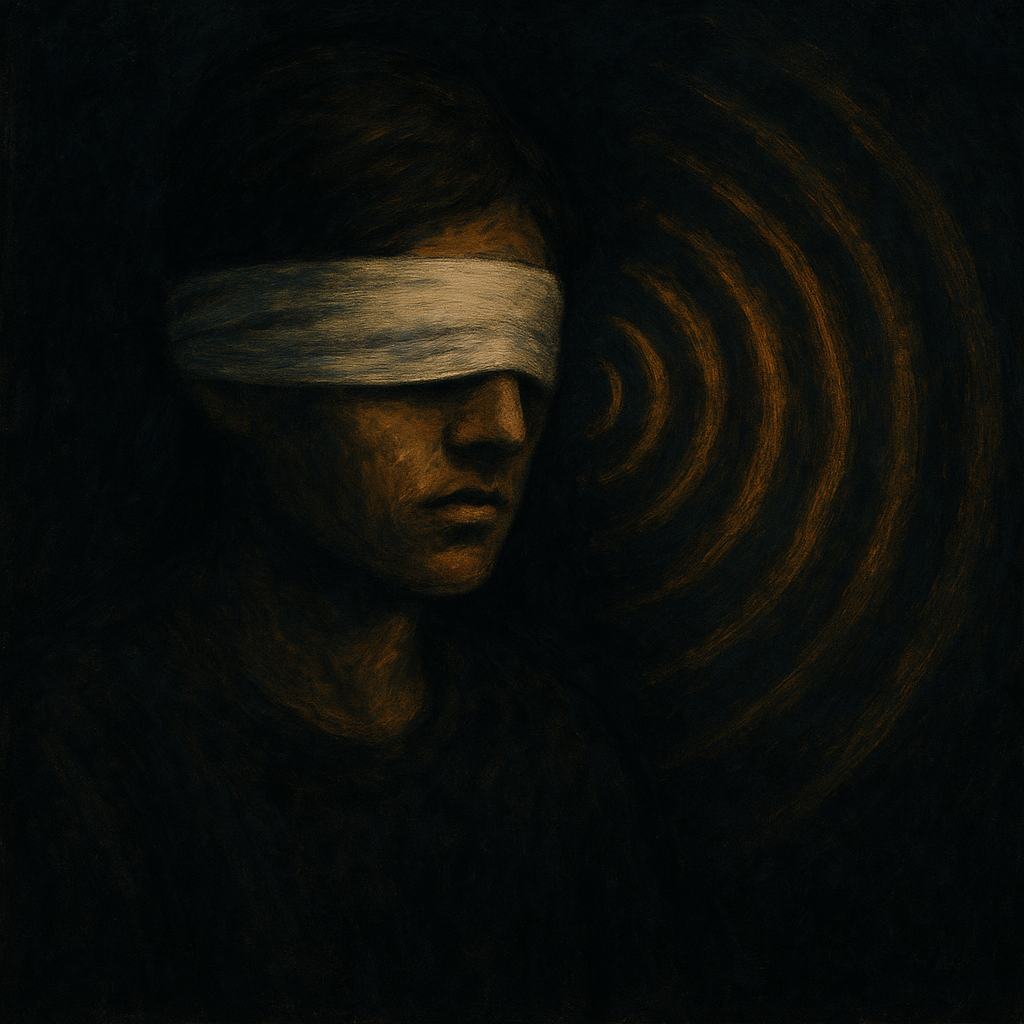
At the literal level, the couplet expresses an unusual desire: the speaker asks to be blindfolded, not to avoid seeing darkness but to enter it completely. Yet the true power of the lines lies in the suggestive field they create. The blindfold is not simply cloth; through dhvani it becomes an emblem of emotional exhaustion, a refusal to face harsh realities, or a longing for withdrawal. The speaker’s request that “someone” impose the blindfold is left deliberately vague, allowing readers to project their own figures—beloved, memory, fate, society—into that space. The poem becomes a receptacle for the reader’s imagination.
The second line extends the paradox. One normally removes a blindfold in order to see; here, the speaker seeks the blindfold precisely to “see” darkness. The darkness becomes a metaphor for inner despair, existential void, or emotional night. The couplet aesthetically affirms this darkness; it does not question or analyse it. Its ambiguity invites readers to recognise their own wounds within it, transforming sorrow into an aesthetic mood. In this moment, poetry validates emotional subjectivity but may also shield the reader from engaging with the deeper conflicts that underlie the emotion.
This couplet, in its brief compass, demonstrates the central argument of this essay: poetry’s ambiguity and suggestiveness can enrich emotional life but may also entangle us further in it. Its beauty can blindfold us gently, enabling us to “see” only the darkness we already carry. Appreciating poetry without surrendering to its enchantment requires a delicate balance between emotional savour and critical insight. Only then can poetry be an invitation to transformation rather than a beautiful barrier against it.