

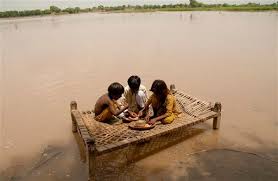
When rivers swell in fury across Pakistan, drowning fields, homes, and histories alike, some privileged voices in our cities and romantic poets rise to offer explanations. They speak of the “wrath of the river gods,” of rivers reclaiming their ancient beds, of humans daring to transgress divine pathways. They say the floods are punishment for encroachment, that the poor who build huts on the riverbanks invite disaster upon themselves.
This is not just romanticism—it is cruelty masked as wisdom. It is easier, after all, to anthropomorphize a river than to confront the deep injustices baked into our political economy. Such a view displaces blame onto those least responsible, those already clutching the fraying edge of survival. The farmer who builds on a river’s margin does not do so out of arrogance, but out of desperation. Land that is “safe” and “secure,” that rests above the seasonal floodline, has long been monopolised by landlords and urban investors. For the landless poor, the only option is the precarious fringe: the embanked zones that are at once fertile and death-trapped.
When embankments breach—and they do, regularly—it is not the poet in Lahore and Multan or the environmentalist in Islamabad who loses a roof, a goat, a child. It is often the peasant woman whose mud house is pulled apart like paper; it is the herder who watches cattle, his only wealth, swept away in torrents of brown water. To romanticise rivers while ignoring the asymmetry of power that pushes the poor into danger zones is not ecology. It is victim-blaming, dressed up in lyrical metaphors.
But the dangers of this urban neo-romanticism run deeper. Not only does it blame the victims, it also diverts attention away from the actual culprits of our riverine tragedies. Floods in Pakistan are not “acts of god,” nor are they punishments for ecological hubris. They are the manufactured outcomes of decades of arrogant, extractive engineering, underwritten by the greed of international financial institutions and legitimised by the pseudo-science of dam lobbies.
The river was not always a “monster.” It was made monstrous by men who sought to chain it. Engineers in crisp uniforms, backed by World Bank dollars and IMF blueprints, set out to dam rivers, straighten channels, and wall off floodplains with embankments. They worshipped at the altar of modernity and “control,” believing their formulas transcended the messy realities of ecology and society. The result was a tortured hydrology: rivers stripped of their seasonal rhythms, floodplains narrowed and weakened, ecological balance uprooted.
Corrupt bureaucrats and contractors joined hands with these engineers, seeing in each embankment project another contract, another kickback, another cement monument to their short-sightedness. Dams and barrages were sold to the public as miracles of progress. But for the people living on their margins, they were ticking bombs. Each embankment breach is not an accident; it is the logical consequence of a worldview that sought to dominate rivers rather than live with them.
History offers ample evidence of who truly benefited from these interventions—and it was not the poor. Patrick McCully, in his classic Silenced Rivers: The Ecology and Politics of Large Dams, documents how international financial institutions pushed dam projects across the Global South, framing them as development but reaping profits for contractors, consultants, and elite bureaucracies. Pakistan is no exception.
The Indus Basin Treaty of 1960, brokered by the World Bank, was hailed as a triumph of diplomacy. But for the rivers, it was a partition—an amputation. Sutlej, Beas, Ravi: rivers that once pulsed with life were sacrificed, their flows diverted into cement canals and storage dams. The treaty fractured the ecological unity of the Indus system, reducing rivers to pipelines of “usable water.” Dams like Mangla and Tarbela emerged, heralded as national pride, but in reality serving the irrigation needs of elite landlords and the industrial farming model of the Green Revolution.
Nowhere has this ecological violence been more visible than in the Indus Delta, once a lush cradle of mangroves, fisheries, and fertile lands. Starved of freshwater because of upstream diversions, the Delta has withered into a saline wasteland, destroying livelihoods of fishing and farming communities who for centuries lived in symbiosis with the tides. Their plight is a stark reminder that the politics of partitioning rivers ripples far beyond canals and dams—it reaches the sea itself.
Who benefited? The dam builders, the financial institutions, the engineers clustered in powerful bureaucracies like WAPDA, monopolized largely by technocrats from Punjab. Who lost? The small farmers whose self-reliant ecologies—diverse cropping, flood-recession farming, fishing economies—were marginalized. Local cultures of resilience were replaced with monocropping, chemical dependency, and irrigation regimes vulnerable to both drought and flood.
Meanwhile, the fossil fuel lobbies and urban middle classes, the greatest consumers of energy and benefactors of “economic growth,” carry on relatively insulated from the disasters their privileges aggravate. The poor, conversely, inherit both drought and flood: rivers denied them in summer, unleashed upon them in monsoon. Climate change only intensifies the cycle, adding unpredictability to a system already disfigured by decades of bad policy and greed.
In recent years, a new layer of risk has emerged from urban real estate developers and authorities—such as the Ravi Urban Development Authority (RUDA) in Pakistan—who are pushing large-scale housing and commercial projects directly onto riverbeds and floodplains. Unlike traditional dams that obstruct and regulate rivers, these encroachments suffocate natural floodways, intensify urban flooding, and displace vulnerable riverbank communities. By treating rivers as real estate rather than living ecosystems, such projects prioritize short-term profit over ecological safety and collective well-being, effectively transferring the costs of disaster onto ordinary people while eroding natural resilience against floods and climate change.
It is here that justice demands a reckoning. The poor who live behind embankments are not passive “encroachers.” They are the victims of a political ecology designed to exclude them from safety and include them in disaster. Each washed-away home is an indictment, not of some mystical river, but of a system that dammed and damned the river simultaneously.
To tell them the floods are divine justice is obscene. To say that rivers have “rights” while the people drowning in them have none is a grotesque inversion of morality. The urban estranged environmentalist and romantic poets offer no solace to the woman who must carry her children on her shoulders through waist-deep water. Only a politics of accountability—naming the international financiers, the dam lobbies, the bureaucratic institutions, the fossil fuel barons—can offer dignity to those who suffer.
If we are to speak of gods, then let us say plainly: it was not the river that betrayed the people. It was powerful institutions and rich classes, and real estate investors that betrayed both rivers and people alike. The true monsters are not the waters but the institutions that profited from controlling them, the elites who sit safely while the poor drown.
Until we indict the dam builders, the financiers, and the fossil fuel profiteers, we will remain trapped in this cycle of devastation. Romanticism will not rebuild homes. Poetic deification will not feed livestock. Compassion without justice is a hollow offering.
The floods in Pakistan demand more than mourning. They demand clarity: the courage to reject perverted ecologies and confront the real engines of destruction. The poor who live and die at the river’s edge deserve no less.