

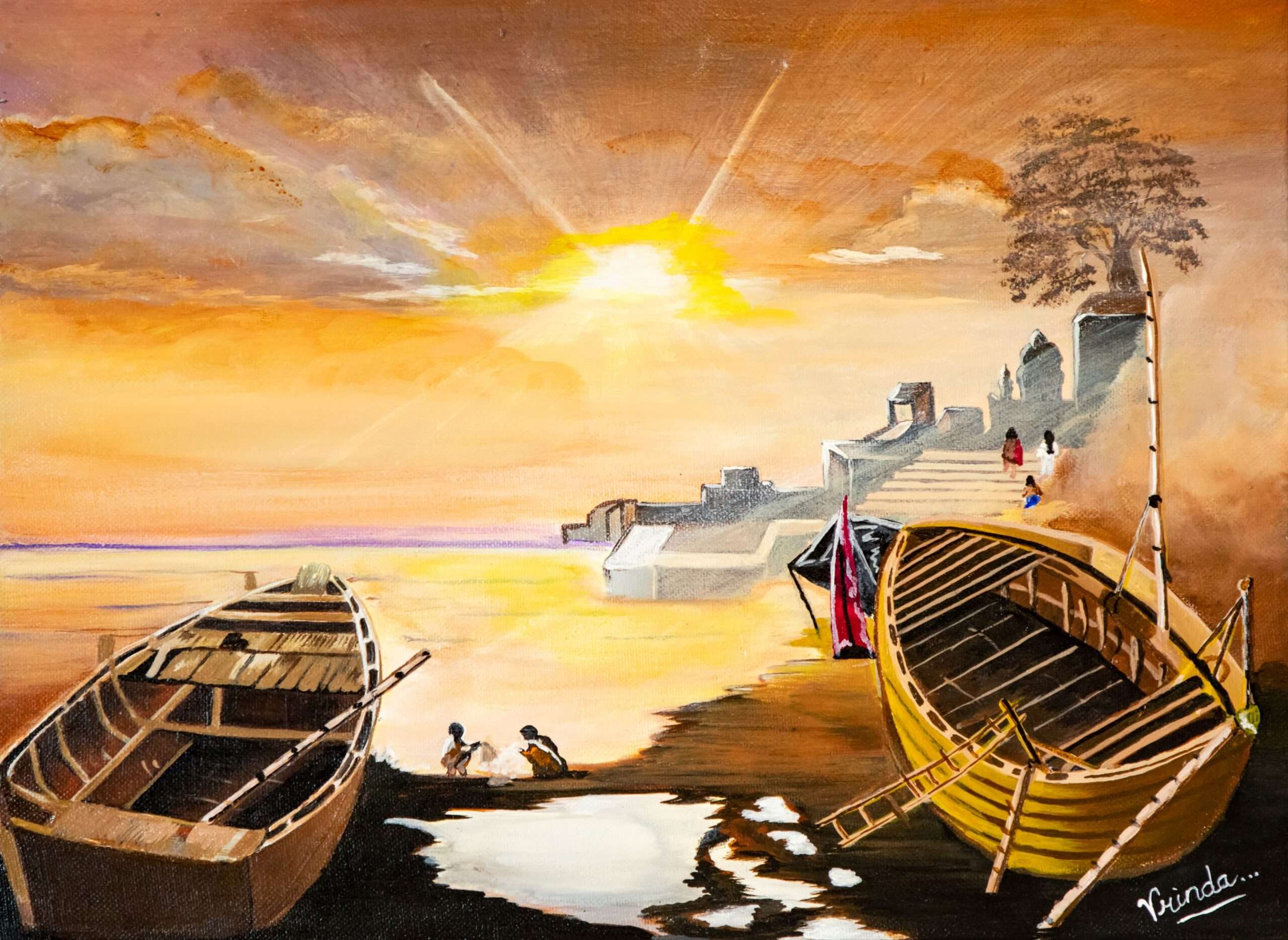
It is urgent to live enchanted.
Valter Hugo Mae
During the floods, I noticed something unusual. The communities from the Siraiki belt did not protest with furious cries or confrontation. Their protest was of another kind — deeply passive, wrapped in silence and sorrow. It was not the defiant voice of those who demand justice, but the muted endurance of those who have accepted suffering as fate. The mood was melancholic, heavy, yet calm — without any gesture of anger or resistance. The women and men sat together, their eyes vacant, their bodies still, as if grief had turned into a quiet ritual. In other places, among other peoples, I have seen despair mixed with defiance. There, grief is often clothed in anger — a will to resist, to survive, to demand. But in Siraiki Wasaib, sorrow appears unblended. It is pure, undisturbed by rebellion — like a river that has given up carving new paths and flows obediently into its own drowning.
Why are the Siraiki people so deeply melancholic that melancholy itself becomes their central mood — their home emotion? It is as if Victor Hugo’s words were written for them: “Melancholy is the happiness of being sad.” They seem to derive a strange dignity from their sadness, as if sorrow were their ancestral land and joy, an intruder. The poets of the region do not challenge this inheritance; they sanctify it. Through their poems, they polish the sorrow till it shines. In their verses, mourning becomes melody, and grief, grace. This is what I call poor mimetics: instead of imitating joy or transformation, the poets mimic their own despair. They weave verses that glorify loss and longing, enriching the very emotion that imprisons them.
There is, of course, nothing wrong with melancholy itself. Judith Butler has written that the capacity to mourn is among the finest proofs of our humanity. To grieve is to acknowledge attachment, and therefore, life. Susan Cain, in her work Bittersweet, reminds us that there is beauty even in sadness — that longing and impermanence lend sweetness to human experience. Yet, when sadness grows without proportion — when it becomes the only lens through which a people view themselves — it turns from a teacher into a tyrant. Among the Siraikis, melancholy seems to have become hereditary, both a mood and a worldview. It denies the possibility of other emotions — of laughter, of play, of wonder, of anger. It whispers to the heart: “Nothing can change.” Thus, sorrow becomes an echo chamber; we keep hearing our pain in newer tones and mistake it for truth.
We must remember that emotions are not eternal substances buried in the soul. They are cultivated, like crops, through culture and art. This was known to our ancestors. The Natya Shastra, written nearly three thousand years ago, offered a remarkable insight — that emotion (bhava) and aesthetic experience (rasa) are created through drama, music, and performance. Rasa is not merely felt; it is evoked, constructed, and shared. Through art, one learns how to feel — and what to feel. The text describes nine primary rasas, from love (shringara) to wonder (adbhuta), from fury (raudra) to peace (shanta). Each rasa is a world of feeling cultivated by performance, not simply born in the body. Thus, a society’s emotional life is not destiny; it is an art form that can be remade.
Later, during the flowering of Krishna Bhakti, India witnessed a collective experiment in emotional cultivation. The movement invited the heart into love play — ras leela. Two key rasas animated this bhakti: madhuram (enchantment, sweetness) and viraha (separation, longing). Together, they formed a complete emotional circle. When Krishna departs, the devotee’s heart burns with viraha; when he returns, the world blooms in madhuram. Both emotions feed off each other — longing makes reunion sweeter, and sweetness makes separation more bearable. This was not an ascetic emotion; it was charged with colour and desire. Bhakti re-enchanted life that had grown colourless under the heavy austerities of Buddhism, Jainism, and early Brahmanism. Those traditions preached virag — detachment, the cooling of desire. But Krishna Bhakti declared: without desire, there are no colours; without longing, no love. Krishna, the Man-Mohana, steals our hearts only to show that maya — illusion — can itself be divine play.
Modern research appears to confirm this long-held intuition. Neuroscientist Lisa Feldman Barrett argues that emotions are not hard-wired biological reflexes. They are constructed by the brain through concepts, culture, and learned expectations. When we label a bodily sensation as “grief” or “joy”, we are not discovering an innate truth; we are performing a cultural act. Emotions, therefore, are not universal storms of biology but local weathers of meaning. A Siraiki’s sorrow, a Tamil’s devotion, a Punjabi’s thrill and exuberance — each is a learned composition, a neural poetry written by generations. If this is true, then our melancholy too is not our fate; it is our art — one that can be rewritten.
The Siraiki plains, cradle of ancient Indus civilisation, were once a centre of Bhakti thought in north-western India. Long before Krishna’s flute was heard here, Prahlad, the child devotee of Vishnu, embodied the intellectual Bhakti of surrender. Later, Krishna Bhakti blossomed in this region of the Middle Indus, shaping local poetry and mysticism. In early modern times, its echoes resounded in the kafis of Khawaja Ghulam Farid. His verses sang of longing (viraha) — the pain of separation from the Beloved and joy of union. But somewhere along the centuries, we forgot madhuram, the rasa of sweetness and enchantment. We are also, by and large, deprived of experiencing other emotions such as hope and anger. The result is that our culture has become asymmetrical — rich in sorrow, poor in seeking delight. The pathos in our Hussaini marsiyas, the ritual of matam during Muharram, and the everyday idioms of regret and fatalism all point to this overgrowth of melancholy. It has become not merely an emotion but a system — a cultural pathology.
It is urgent, then, to live enchanted again. To rediscover the rasa of madhuram — the sweetness of being alive, of seeing colours return to our grey fields of feeling. To live enchanted does not mean to deny pain; it means to refuse to make pain our only truth. Every culture needs its mourning, but it also needs its laughter, its song, its play. Bhakti once taught us to balance viraha with madhuram — to long deeply, but to rejoice equally when touched by beauty. We must bring back that rhythm, that pendulum swing between ache and awe.
Culture often perpetuates itself through mimicry. Our poets, singers, and storytellers become mirrors of our moods. When the collective mood is sorrowful, they polish the mirror of sorrow further, thinking it is beauty. But art must not only mirror; it must also illuminate. To break the chain of melancholy, we must begin with poetry itself — by writing new songs of wonder, by imagining joy not as denial but as depth. The politics of our region, too, must unlearn its habit of despair. It must reclaim hope as a legitimate emotion.
Only when criticism of poetry and politics join hands can a new emotional horizon open for us. The Siraiki heart, so steeped in mourning, must learn again the art of enchantment — of being moved by colour, play, and possibility. For too long, we have mistaken endurance for grace and sorrow for wisdom.
To live enchanted, then, is not a luxury; it is an urgency. For without enchantment, despair becomes destiny. And when a people lose their capacity to be enchanted, they lose not only joy — they lose the imagination of change itself.