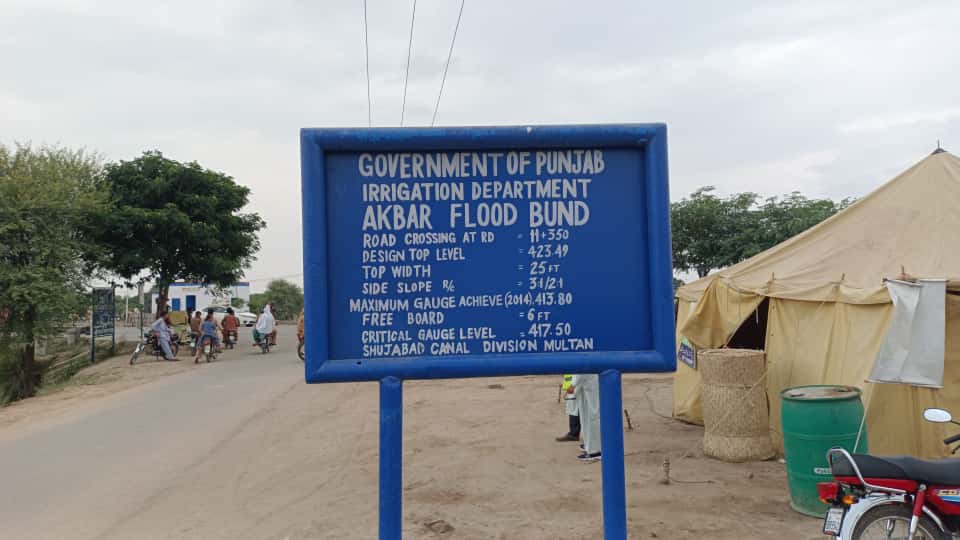
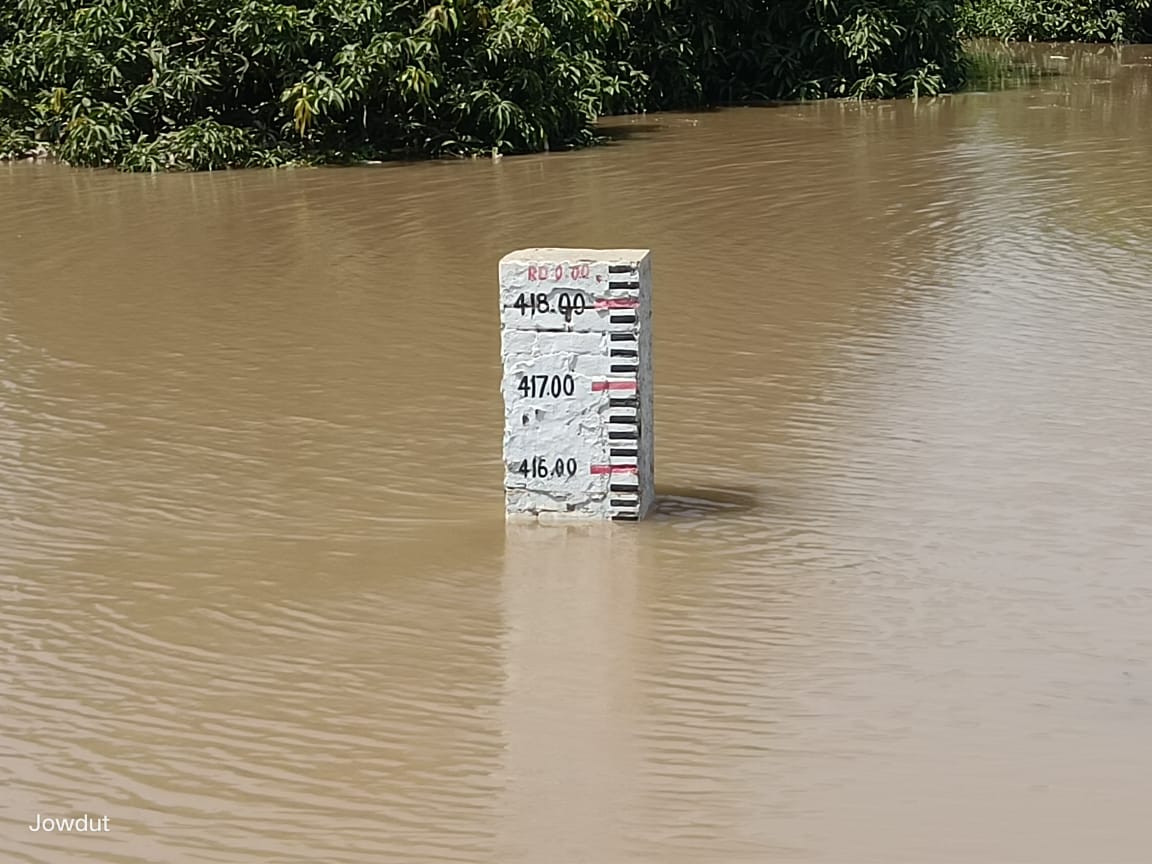
The River Chenab swelled to a maximum gauge of 414 feet at Muhammad Wala Road, Akbar Bund, Multan, on September 4, 2025—a height not seen in more than a decade. A signboard still stands there, reminding passersby that in 2014 the river had peaked at 413.80 feet, forcing the authorities to breach the road in order to release the pressure.
But this time, the water has risen even higher, and the authorities are hesitant.
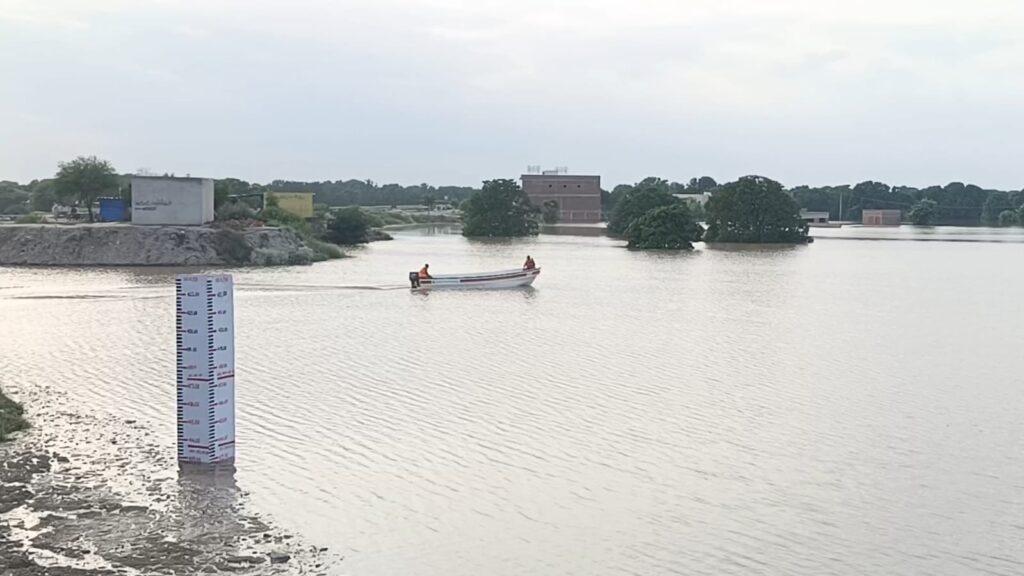
Akbar Band Muhammad Wala Road, 3 September 2025
Multan has been drowned, not just in floodwaters, but in the failures of climate change, governance, and human neglect. No matter how much one tries, it is difficult to put into words the toll this disaster has taken—on the people, on their mental health, and even on the journalists who stand in knee-deep waters to tell their stories.
To understand the human toll, one has to walk into Old Sher Shah, a modest settlement tucked beside the railway station. Here, the river is not just a distant force of nature—it is an unwelcome visitor that barges into homes, orchards, and fields.
Sitting on the crumbling steps of his house, Nasir Abbas recalls the flood of 2014. “The waters were five feet less than they are today,” he says, his voice heavy with frustration. “Yet back then, they breached the bund to protect us. Now, they refuse. Why are we being sacrificed this time?”
Beside him sits Khuda Baksh, a 72-year-old farmer with weathered hands and tired eyes. “I’ve seen floods since 1992,” he says softly, “but never have I seen the state so reluctant to save its people. They are drowning us—our homes, our fields, our livelihoods.”
Both men allege that powerful hotel owners have pressured the government not to breach the Sher Shah bund, fearing damage to their businesses. “So our lives,” Nasir adds bitterly, “are worth less than their profits.”
People cry when they see us. They call out, desperate for someone to listen. And then there are the rare, humbling moments—like when a displaced family finally finds shelter in a camp, and their little children recognize us. They run up, smiling through misery, offering us cold drinks as a thank you. I don’t accept, of course. Instead, I tell them softly, “Remember me in your prayers.”
In 2014, Old Sher Shah was swallowed by the Chenab flood. Entire orchards were inundated, crops were flattened, and homes washed away. For many, the trauma has never faded—and today, as the waters creep closer, the fear feels even sharper. This year, the devastation is far worse. According to official figures, nearly 47,000 acres of fertile land have been destroyed in Multan district alone, while more than 400,000 people have been displaced. Families who once depended on their crops and orchards now find themselves homeless, their livelihoods wiped away in a matter of days.
I have met people whose lives were already buried under debt and legal battles. Now their homes stand drowned under 15 feet of water. Justice remains their only concern, even as they lose everything else. It is traumatic, disturbing, and endlessly heavy on the soul.
One moment I will never forget was with Saraiki poet Baqir Hussain Shafi. His house was under water, and he came with us in our boat to rescue his family. We saved them, but he was still restless. I asked him why, and his reply pierced me:
“My books… my poetry. They are still inside. Can we get those too?”
We did. And when he held those soaked but surviving pages, the light on his face, the relief, the joy was more powerful than words. Even in disaster, something of the soul could be saved.
But others, reckless in their desperation, begged us for rescue boats only to vanish into their homes, never returning despite our calls. In the end, we had to alert the LEAs to find them.
The tragedy of Multan’s floods is not just in the water’s force, but in the constructed geography of the city itself. The Chenab twists and turns before meeting the Punjnad and eventually the Indus. These sharp curves—exacerbated by state and non-state encroachments—slow its natural flow, pushing water into the homes of the poor who live in the riverine belt. They live here because the land is cheap, because nowhere else will accept them.
And yet, experts argue that the crisis could be managed differently. If Muhammad Wala Road or Sher Shah bund had been strategically breached, the water might have drained faster, sparing countless families. Beyond short-term relief, they say, Pakistan needs a long-term vision for rivers flowing through the plains. Instead of chasing mega-dams, the state could invest in ponds, wetlands, and aquaculture-based livelihoods along the Chenab. These would store water, curb flooding, absorb harmful gases, and give riverine communities a way to live with the river rather than against it.
For now, though, the people of Old Sher Shah wait. The Chenab roars outside their doors, while their voices—pleading, angry, and weary—struggle to be heard over the rush of the water. These floods are not just waters spilling over the land. They are a calamity swallowing homes, histories, livelihoods, and memories. A disaster not measured only in numbers, but in broken hearts and surviving fragments of hope.