

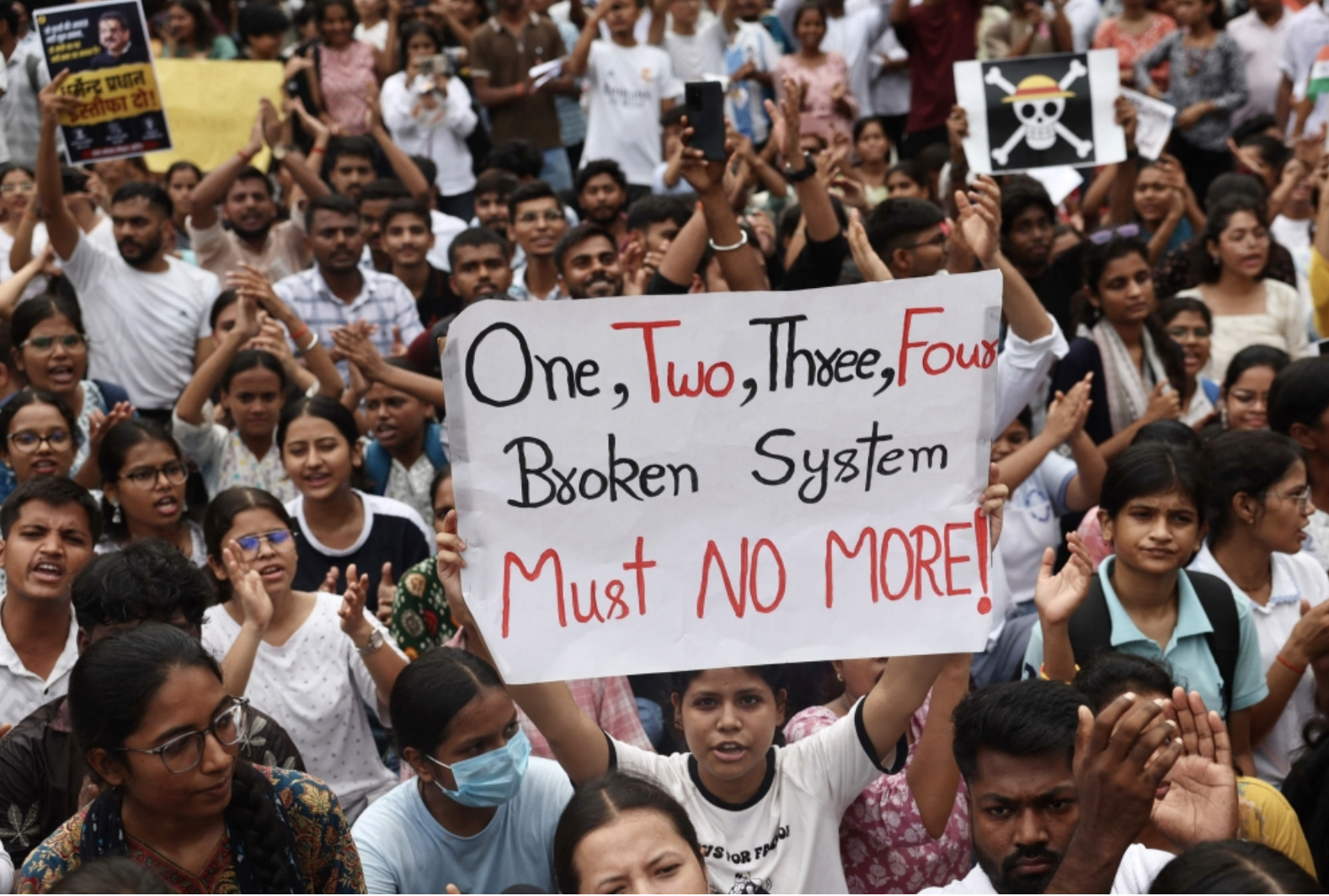
Delhi is full of tear gas again. For over a month, young people have camped at Jantar Mantar. They call themselves the Cockroach Janta Party. The name is a joke, and the joke is the point. A cockroach survives everything. You cannot dignify it with repression. The trigger was an exam paper leak that touched two million students. The demand is a minister’s resignation. But the anger is older and larger than one leak. It is about jobs that do not exist, merit that does not count, and a future that keeps receding. Here is the puzzle. The grievances are material, the oldest kind. Yet they arrive on the street without any material organisation behind them. No union. No party. No leader. Why?
For a century, material anger had a home. That home was the labour movement. A union was more than a wage machine. It was a school of politics. It taught patience, programme, and organisation. It produced cadre. In our subcontinent, the unions and kisan sabhas fed the anti-colonial struggle and later the democratic one. A worker learnt politics at the workplace and carried it into the nation. That school is now closed. Work became informal, scattered, and precarious. The factory floor gave way to the delivery app. Today’s young protesters have inherited the grievances of labour but not its school. They were never going to be organised at work. There is no work.
In the 1970s and 80s, theorists in the West announced a new kind of movement. The old politics of bread was over, they said. The new movements were about identity, ecology, peace, and personal autonomy. They were post-material. The educated middle class carried them, not the working class. Today’s youth movements of the South turn this thesis on its head. The form is post-material: leaderless, digital, satirical, born on the phone. The content is stubbornly material: jobs, exams, prices, corruption. Old bread, new basket.
The youth are not the only claimants to this anger. Right-wing populism got there first. In Europe and America it harvested the same precarity and the same rage against elites, and turned them upward into nationalism. Populism is material anger organised from above, by a leader, against a scapegoat. It fills the space the labour movement left empty.
So two forms now compete for the same vacant space. Populism from above. Connective youth movements from below. The question of our time in South Asia is simple. When the street empties the throne, who fills it?
The record of the youth movements is impressive and incomplete. Sri Lanka’s Aragalaya removed a president in 2022. Bangladesh’s students removed a prime minister in 2024. Nepal’s Gen Z removed a government in 2025 within days. Kenya’s youth shook a national budget. These movements are superb at one thing: delegitimation. They can make a ruler impossible. But they cannot make a successor. They have no cadre, no programme, no candidate. So the vacated space is filled by others. Sri Lanka first got the establishment’s own insider, and only later, through the ballot, a new dispensation. Nepal cycled back towards the same party elites within months. The movement wins the street and loses the succession.
Bangladesh is the hardest lesson. The students’ aspiration was genuinely democratic. That must be said clearly. They rose against a suffocating regime and paid in blood. But look at what filled the vacuum. An unelected interim arrangement with no clear mandate and no clear clock. A larger footprint for the military and the bureaucracy in daily governance. The rehabilitation of religious-right forces that the movement never chose. And a politics of retribution against the fallen party that forecloses any meaningful reconciliation. The revolution was young; the beneficiaries are old. This is not an argument for the fallen regime. It is an argument about form. A movement that cannot govern hands its victory to whoever can. In Dhaka, that meant the barracks, the secretariat, and the seminary.
Pakistan offers a darker variant. Here the youth wave was not an eruption. It was a production. The establishment has long known how to manufacture dissent against democratic dispensations. The lawyers’ movement of the late Musharraf years was the laboratory test, run in Punjab. The PTI experiment scaled it up, run in both Pakhtunkhwa and Punjab with far greater resources: media, money, and curated celebrity. The conditions were real. Unemployment and inflation exist in Pakistan as everywhere. But the anger’s expression was designed. Its direction, its target, and its vessel were built in the workshop of the state. The proof lies in the geography. If this had been the organic anger of the deprived, the South would have risen first. Sindh, the Siraiki Wasaib, and Balochistan are poorer than the mobilised provinces. Yet the South stayed aloof, and its own genuine movements remained dissident and repressed. Mobilisation followed the map of cultivation, not the map of deprivation. Pakhtunkhwa needs a finer reading here. Deprived pockets there did join, and this looks like an exception. It is not. The raw material in Pakhtunkhwa was different. Decades of the jihadi experiment had already built the state’s mobilising infrastructure in the region: the networks, the vocabulary of sacred struggle, the habit of directed mobilisation. And the identity of Khan gave the project an ethnic anchor that no southern region was offered. Deprivation in Pakhtunkhwa flowed into the project through channels the state had dug long before. The exception confirms the rule. Young people thought they were storming the citadel. They were marching in a parade the citadel itself had arranged. Then the creature turned on its maker. The establishment punctured its own project, driven by its own compulsions and contradictions. What remains is embittered youth whose anger has no vessel at all, neither party nor movement nor union. Bangladesh shows a vacuum filled by the wrong forces. Pakistan shows dissent manufactured, deployed, and then dismantled by the same hand.
Which brings us back to Delhi. India’s rulers have more capacity to absorb this challenge than Dhaka or Kathmandu had. An electoral majority, a cohesive security apparatus, a compliant media. The likely outcome is a concession, not a rupture. But outcomes are not the only measure. The Cockroach protests have already broken a fear barrier, reopened public space, and shifted the axis of opposition from identity to accountability. Three trajectories now sit side by side in one region. India’s vacuum is still open. Bangladesh’s was filled by the wrong forces. Pakistan’s was sealed by the hand that made it. Youth mobilisation is now the primary form of mass politics in South Asia. It has no politics of its own. It becomes whatever fills it. The task of this generation is not to march better. It is to build the vessel.