

جئیں مَن مَندر پایا پِیا
ݙُکھ پاپ سارا مِٹ ڳیا
تھی مَحو اَثباتی تھیا
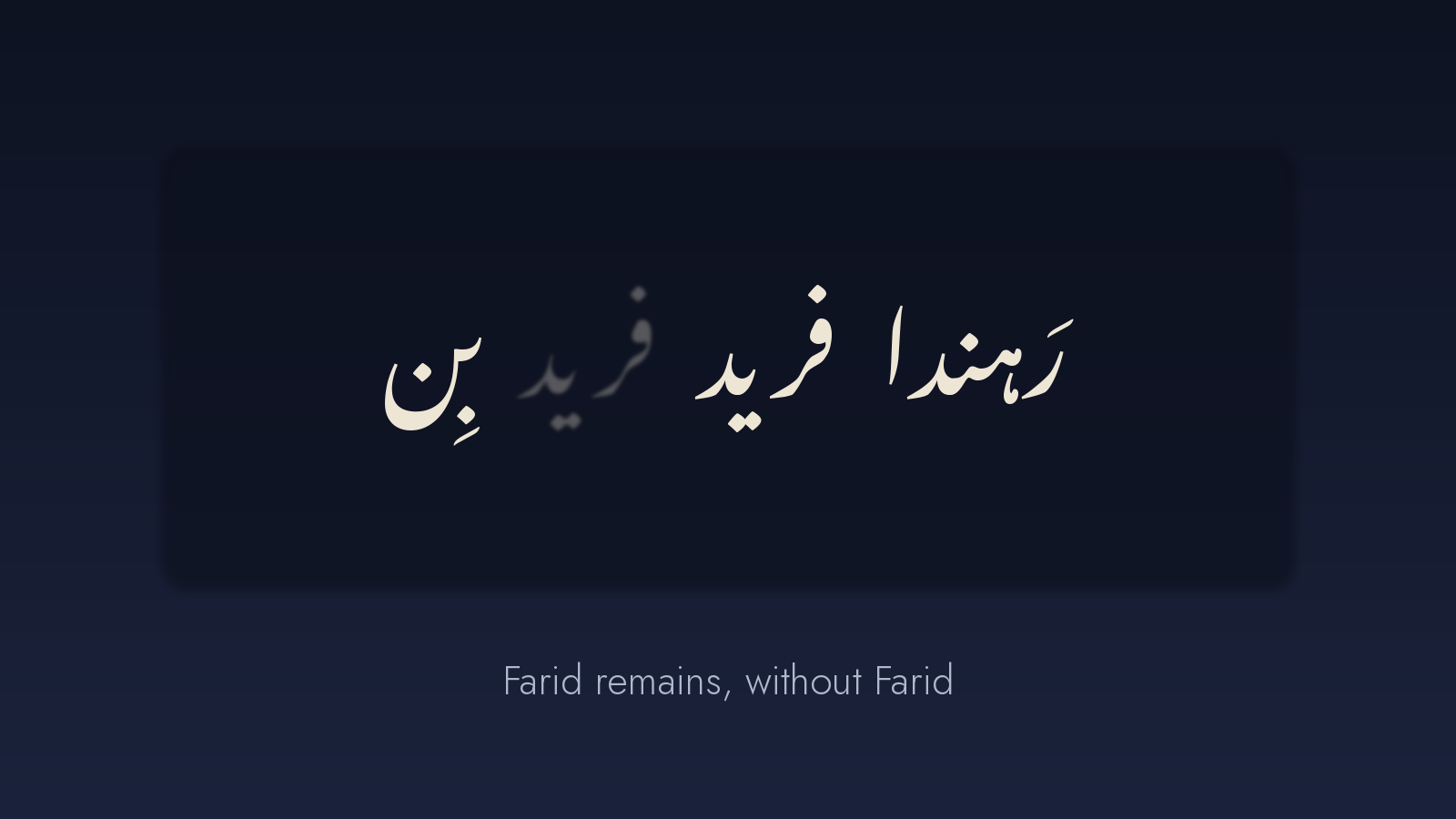
رَہندا فرید فرید بِن
These four lines close Kafi 100, a poem spoken through the coded figure of the Rawal jogi. That code I have treated elsewhere. Here the band stands alone, for it carries a complete teaching on identity within itself.
What remains of a man when his name is emptied? Why does a poet sign the very poem in which he announces his own erasure? How does a name go on answering after its bearer has withdrawn? All three questions rise from the final line. Rahnda Farid, Farid bin. Farid remains, without Farid. One name, twice, in a single breath. The first remains. The second is gone. What divides them?
One Arabic word answers: mahw, and it is worth pausing on. Mahw means erasure. Not destruction, erasure. In its oldest sense it is a scribe’s word, the wiping of ink from a tablet, so that the writing goes and the tablet stays, clean and ready. The Qur’an pairs it with ithbat, establishment (13:39), and the Sufi masters systematised the pair: Qushayri defines mahw as the lifting of the servant’s attributes, and ithbat as the establishment of what replaces them. The essential point is that the substrate survives.
Now read the band as a single movement rather than four statements. The first line does not merely report a discovery. Paya means both to find and to place: the Beloved is found in the temple of the heart the way an idol is installed in its mandir. And a heart, like a sanctum, cannot host two. The moment the piya enters, the resident self is displaced. The second line records the consequence. Dukh and pap, suffering and sin, are wiped away entire, not because they are pardoned but because they have lost their host. Sin needs a sinner. Suffering needs a sufferer. The self is not the victim of pain but the page on which pain is written, and the page has just been claimed by another. The third line names this exchange in Arabic: mahw, the wiping of the old inscription; ithbat, the establishment of what replaces it. The fourth line then exhibits the result. The second Farid, the writing, the ego with its biography, its claims, its grievances and its fears, is gone. The first Farid, the tablet, the name as address, remains. Each line hands its work to the next: arrival, erasure, naming, remaining. The last line is not an ornament appended to the band. It is the sum the first three lines have been computing. And the salvation it announces does not rescue the self. It releases from it.
Modern theory circled this spot much later. Lacan defined the signifier as “that which represents the subject for another signifier”: the name stands for the person but never contains him, and the living subject slips perpetually beneath his own name. Theory called this fading a structural wound. Farid calls it the goal. What theory mourns, Farid celebrates. Derrida added that “a written signature implies the actual or empirical nonpresence of the signer”: to sign is already to accept one’s own disappearance. Farid bin is that acceptance set to music.
We live, meanwhile, by the opposite creed. Ours is the age of identity as possession. The self is curated, displayed, defended. It must be asserted to exist and recognised to survive. Its loss is our deepest fear, and a whole economy now feeds on that fear. Against this, the band proposes identity as a tablet held lightly.
The argument of the band can now be stated in full. Mahw separates the inscription from its substrate: what is erased is the written self, and what survives is the surface that carried it. Applied to a name, this yields a precise doctrine. A name performs two functions. It describes a person, and it addresses one. The description can be erased, for the ego and its biography are writing. The address cannot, for it belongs to those who call, not to the one who is called. This is why dukh and pap vanish with the self that hosted them, and why the fading of the subject, a wound in theory’s account, becomes in Farid’s account the completion of the path. It is also why the last line is not a paradox but a conclusion. Rahnda names what address does once description is gone: it remains. The proof is empirical. For generations, singers have called this name in kafi and qawwali, and it has answered every time, without its owner. Farid remains, without Farid, because a name was never the property of its bearer in the first place. It was always a relation, held out toward others, and a relation does not die with the self that once stood at its centre.
Mushtaq Gaadi
One response to “Emptied Name: Farid without Farid”
سئیں شاندار ،ڈاڈھم دا لکھیے وے پڑھ کے مزہ آئے ۔ ہک شرح لکھو تساں وی انگریزی زبان اچ دیوان فرید دی