

These days the word karma is everywhere. A man loses his work, or his health, or his marriage, and someone tells him gently that it is his karma. It is meant as kindness. It is meant to explain. But look at what the word does. A man is already on the ground. The word bends down and tells him he put himself there. The pain was not enough. Now there is a verdict laid on top of it.
We reach for karma because we cannot bear a suffering that means nothing. This is the oldest hunger of all. The flood, the fever, the cruel death. What we cannot carry is not the pain. It is the randomness. To suffer for no reason is to live under an empty sky. So the mind has always gone looking for a reason. Karma gives the cleanest reason ever found. Nothing is random. Every sorrow is a payment. The ledger is never wrong.
The idea did not come all at once. The oldest religion was a religion of the altar. Men fed the gods with sacrifice, and the gods kept the world in its courses. There was no great question of the soul. There was the rite, and the rite was enough. Suffering was not yet a riddle of the conscience. It was a matter of a broken ritual, or a god neglected, or fortune turning its wheel. There was a kind of happiness in this. The world was thick with gods and spirits, and a man was not yet asked to answer for his own pain. He had only to mend the rite and make his peace with powers larger than himself. We call that mind primitive and our own enlightened. Yet it was spared the cruelty our wisdom would invent. It had not yet learned to look at a suffering man and tell him he was to blame.
Then, in the centuries before our era, something turned, and it did not turn in India alone. In China and in Persia, among the prophets of Israel, in Greece, and on the plains of the Ganges, men began at almost the same time to ask a new kind of question. They were no longer content to keep the world turning. They asked what a life was for, and whether the world as it stood was just, and how a man might be saved from it. The philosopher Karl Jaspers called this the Axial Age, the age on which the later world still turns. Its mark was everywhere the same. Religion left the altar and entered the self. The question was no longer how to feed the gods. The question was the fate of the soul.
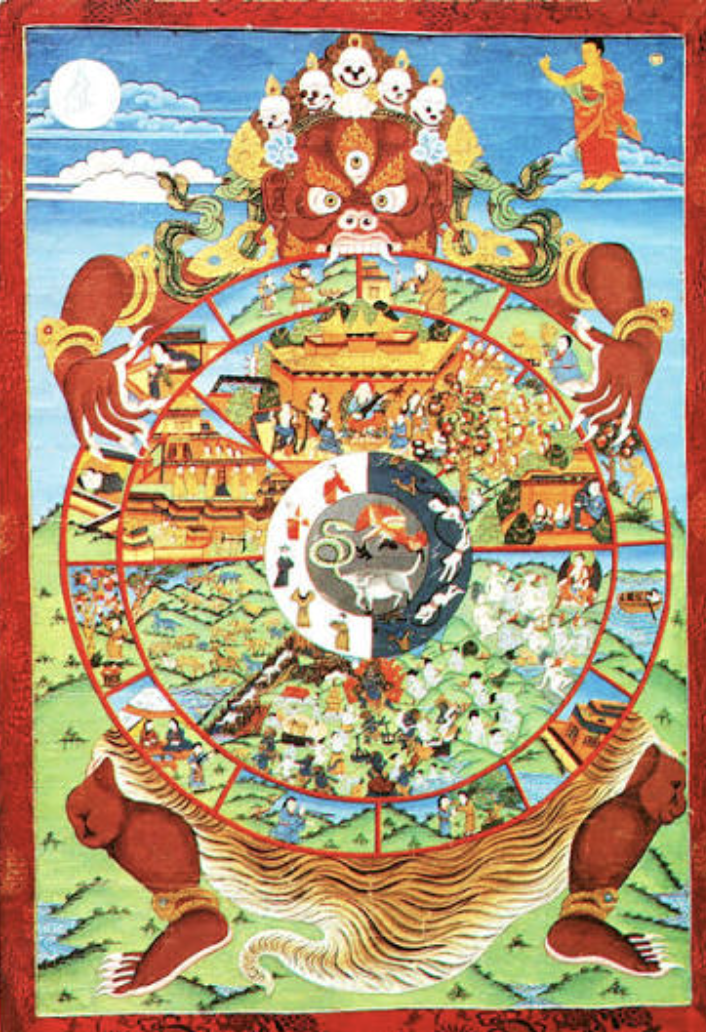
In India this turn was carried by the wanderers. The shramanas, the renouncers who walked out of the village and away from the sacrifice and into the forest, were its sharp edge. From them came the Buddha and the Mahavira. They turned their backs on the priest and his fire. They taught that a man is made not by the rite he pays for but by the deeds he does, and that his deeds follow him out of one life and into the next. Here the old belief in return was married to morality. It was no longer enough to be born again. Now what you were born as was the wage of how you had lived. Good deeds lifted you. Bad deeds sank you. And all of it across lives you could not remember. The Brahmins, who had begun at the altar, were drawn into the same current. They carried the new law of deeds into their own books, and there they wedded it to the order of birth. With that one step rebirth became a court, and every birth became a sentence already passed.
Nietzsche saw this more clearly than anyone. Man does not fear suffering, he said. He fears suffering without meaning. Give the pain a reason and he will not merely bear it. He will reach for it. And the surest way to give pain a meaning is to call it a punishment. So the sufferer is offered a bargain. He takes it. He is told his pain is not empty, but that the price of the meaning is his own guilt. He agrees. He would rather be guilty than be struck for nothing. This is the secret hidden inside karma. Guilt is easier to carry than chaos.
This is what all morality does at its root. It begins as accounting. Right and wrong are first of all credit and debt, a weighing of what is owed. Conscience is that ledger turned back on the self. And the cleverest, cruelest thing any morality ever did was to find the cause of a man’s suffering inside the man. Karma takes that act to its end. It is the ledger written across many lives, and not one entry is ever left unpaid, and not one wound is ever left unjudged.
See this once and you see what karma quietly performs. It lifts the cause of pain from where it truly lies and buries it inside the sufferer. The man is sick from the foul water and the long years of work, but it is called his karma. The child is born into hunger because of the order that keeps her people poor, but it is called her karma. Here the thing turns truly cruel. If the poor are poor by their own old deeds, then poverty is just. The crushed have earned their crushing. The one who does the crushing is only the hand of the law. So the law of deeds, once it was wedded to the order of birth, became over the long centuries the great defence of caste. It told millions their degradation was deserved. It asked them to bear it in silence.
But there was never any guilt in the suffering at all. The child did nothing. The sick man did nothing. The world is innocent of the crimes we read into it. Morality did not find the guilt in our pain. It put the guilt there. Karma is the purest form of that act. It looks on a guiltless world and calls every wound a sentence justly served.
India did not take this in silence. The same ferment that threw up the renouncers threw up their opposite. Its own materialists, the Charvaka, the people called Lokayata, rose against the whole design. They denied the soul and the life to come. When the body is burnt, they said, it does not return. With that one plain sentence they cut the root of karma. No next birth, no debt carried into this one, no hidden crime to explain a present grief. The poor man is not paying for a forgotten sin. He is poor, and his poverty has causes in this world, and causes in this world can be named and fought. So they told people to put down the fear of the ledger and to live this one life well. Their enemies mocked them as mere lovers of pleasure. Their books were lost or burnt, and we know them now mostly through the mouths of the men who hated them. But the rebellion was real. They tried to take the guilt off the back of the sufferer and hand him back his life.
The Charvaka lost. The faith they fought outlived them by two thousand years. And cruel as it was, it was at least a bargain, and an open one. The whole society held it together. To believe was to belong. Every sorrow was weighed on one scale. Priests and rites and a long story carried the weight beside the sufferer. The debt was heavy, but it could be worked off in the company of others who owed the same. The price was steep. It cost a man his freedom. He could not question the verdict and he could not leave the place it gave him. But it gave him something real in return. A world that held him. Others to be held beside.
Now the word remains and the bargain is gone. We pick up karma loosely, fashionably, each of us alone. There is no shared world now. No company in the grief. No rite to work the debt away. There is only the verdict, kept and carried by one man by himself. And here is the last cruelty. The modern man calls this freedom. He says he makes his own fate, that he pulls his fortunes toward himself, that his life lies in his own hand. But it is the oldest bondage wearing a new face. He has kept the blame and thrown away the belonging. He stands alone, in a world that did him no wrong, holding a debt that no one shares, and he tells himself he chose it. The old believer at least suffered among his own. The new one suffers by himself, and calls his loneliness freedom.
One response to “Karma: The Comfort That Blamesـ- Mushtaq Gaadi”
رج سوہنڑی لکھت