

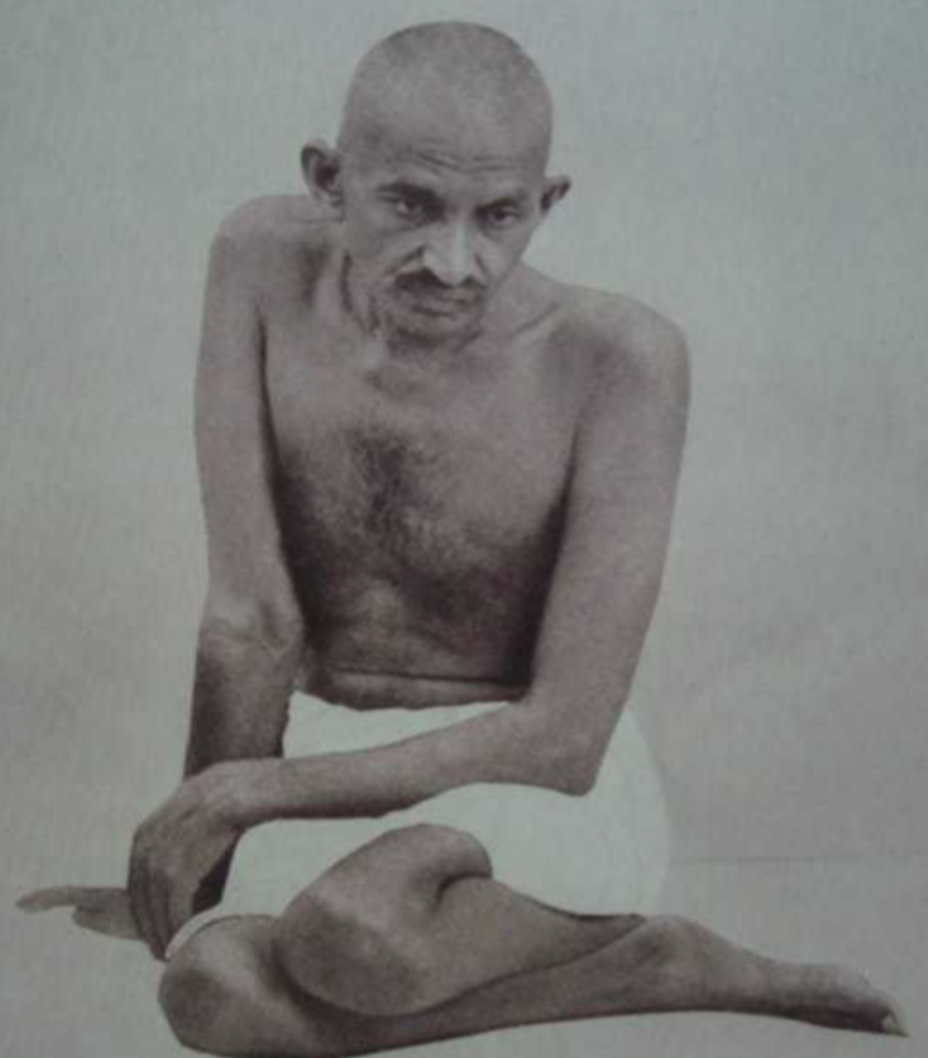
I first met Gandhi in 2000. I read Hind Swaraj. It shook me. The book did not argue with me. It spoke to something already waiting inside me. Soon after, I read The Story of My Experiments with Truth. Then I read everything about him I could find.
When his words reached me I was a thorough Marxist. That is what made it strange. A Marxist is not meant to be shaken by a book like Hind Swaraj. Yet I was. It changed my life and my sense of who I was. I became a vegetarian. I grew critical of the dominant models of development. I began to idealise the self sufficient village and small is beautiful. This took me to the Chashma canal, then being built in my own region, and I stood against it. For this work I left my NGO job. I spent the next fifteen years roaming in villages, meeting people, holding saths with the help of friends.
But I learned something early. To be influenced by a person is not the same as to copy that person. In the end each of us must carve a path in our own circumstances. Idealisation has its own dangers. One should know them.
Take my vegetarianism. I kept it for seventeen years and then I gave it up. Two things turned me. First, it had become my public identity. People knew me by it. A practice had hardened into a label, and a label is a kind of fixation. Second, vegetarianism asks a renunciation of desire, and this went against my Tantric disposition, which honours desire and does not starve it. I still prefer vegetables on my plate. But I no longer keep the rule as a rule.
The idea that guided me most was the experiment with truth. The word experiment carries a radical openness. It bends towards actions and their results. It stands against fixed conviction. Slowly I saw an oxymoron in the phrase. Truth asks for full conviction in your view. Experiment is the enemy of all conviction. Gandhi himself would not accept this reading. For him Truth was not a belief to be sure of. It was Satya, being itself, never owned, only approached. That is why he called them experiments. I know this. Yet the paradox I found was real for me, and it did its work. Holding the two words together freed me. I lost my fear of contradiction. I knew we cannot escape inconsistency, and I stopped pretending we could.
The question of ends and means still troubles me. Here I part from Gandhi. He placed rightful means above all ends. I cannot. I see ends and means as made of each other, each leaning on the other. I have no settled answer. The question stays with me.
There is a harder thing to admit, and it belongs here. Gandhi paid for his ideas with his life. He went to prison. He chose poverty. In the end he was killed for what he held. I paid almost nothing. I once called my years in the villages a sacrifice, but they cost me little that I truly valued. And I have come to suspect my own subtlety. Holding ends and means as interdependent was the finer view, but it was also the door through which I escaped the real cost of my ideals. Gandhi’s absolutism left him no such door. If the means are everything, you must live them now, in your own flesh, at a price. I didn’t pay anything substantial for my ideas.
Gandhi also softened my Siraiki nationalism. My Siraiki identity is still at my centre. I love my land and my language. They are part of my being. But the love has changed its manner. It is now the love of Tagore, of Tolstoy, of Gandhi, of Mandela. It does not stand on hatred of others.
He did the same to my Marxism. I had held it without doubt. I still agree with much of it. The way it reads power, and labour, and how the few live upon the many, still seems true to me. But Gandhi loosened the orthodoxy, and the rigid identity that came with it. I could keep what was true and set down the rest.
There was another matter on which I always differed with him. It was his approach towards sexuality and eros. Gandhi drew his celibacy from his Vaishnava upbringing and its brahmacharya. I was drawn at the same time to the Tantric stream of ancient India, which treats desire and the erotic as the ground of life itself. In time I came to see that his celibacy was a crooked thing. A man who has truly left desire does not need to test himself against it. Yet in his old age, in the name of his experiments, Gandhi slept beside young women to prove his control. The proof he sought was itself the confession. The desire he claimed to have conquered kept returning by the back door.
Now I too am old, and again at a crossroads. I am Gandhian and non-Gandhian at once. I am still searching for the path I must walk at this late stage of my life, the path that should carry me to my Antam Samskar.
Often an old verse of Bhartṛhari returns to me. He left us a hundred verses in praise of love and a hundred in praise of leaving it. Perhaps that is why he comes to me now.
The pleasures were not enjoyed. We ourselves were consumed.
The penances were not performed. We ourselves were burnt.
Time did not pass. We ourselves passed.
Desire did not grow old. We alone grew old.