

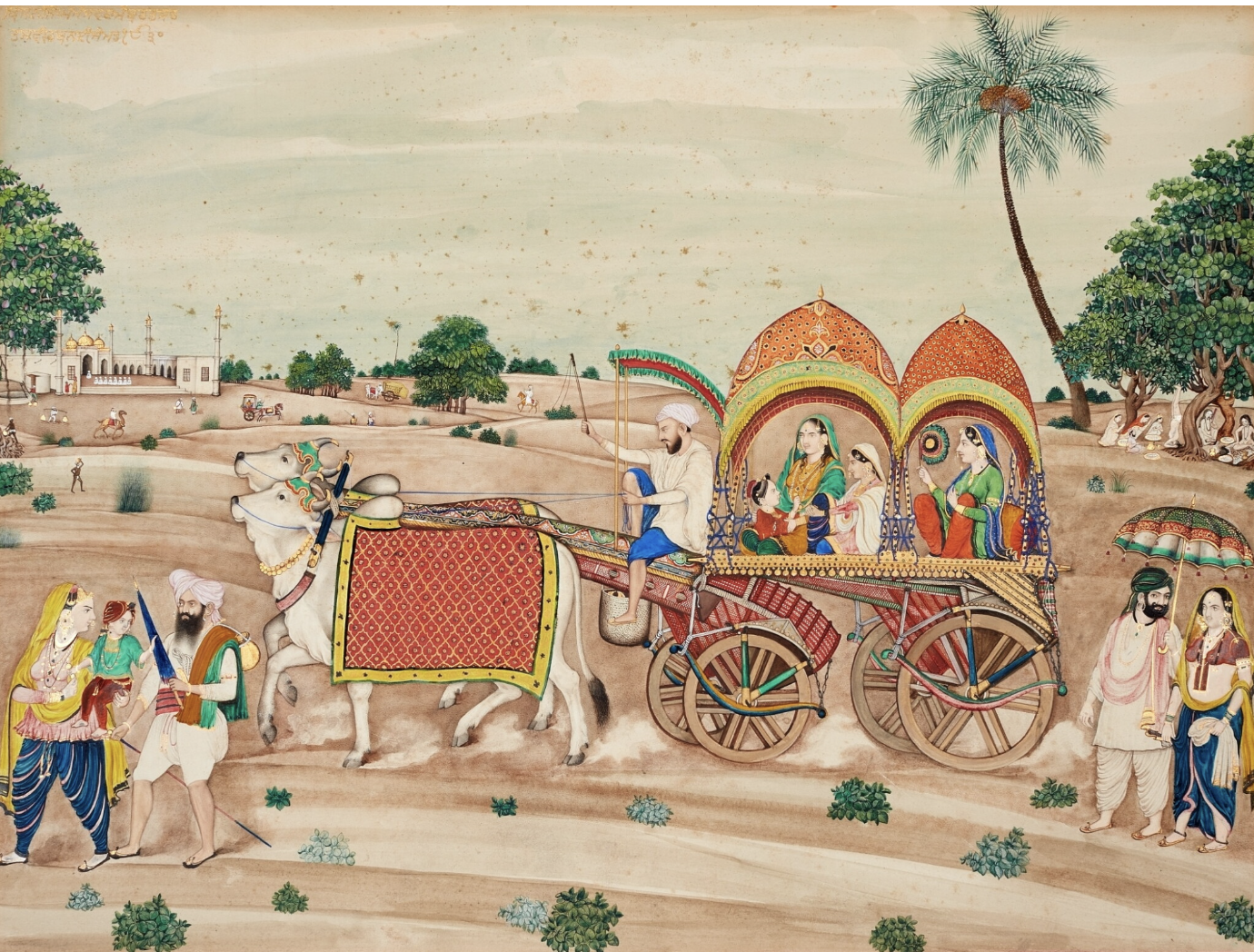
رتھ دھیمے دھیمے ٹور
Drive the cart slowly: a reading of Khwaja Ghulam Farid’s Kafi 47
The setting
Most kafis of Khwaja Ghulam Farid are about separation. The lover waits in the Rohi, looks at the clouds, hears the kunj and burns. Kafi 47 is a little different. It is about a journey towards the beloved. A woman is going to meet him and she is sitting in a rath.
In Siraiki a rath is an ox cart often drawn by bullocks. It is the slow cart of village roads, which once carried brides and families from one place to another. So the pace of the poem is slow from the first word.
The refrain is addressed to the driver.
رتھ دھیمے دھیمے ٹور
Drive the cart slowly, slowly.
We would expect a woman going to her beloved to want to hurry. She asks for the opposite. The rest of the kafi gives her reasons.
What she carries
میݙا دَستہ نرم کروڑ دا، مَتاں ونگیں لَگم ٹکور
My bangles are of soft glass. They may get a knock.
Dasta is a set of bangles. Wangeen are glass bangles, the kind a bride wears. Takoor is a knock. If the cart jolts, the bangles may crack. She wants to reach him with her adornment whole.
رتھ تے ٻہندی، دڑگ نہ سَہندی، ہِم طبع کمزور
I sit in the cart but I cannot bear the jolts. My nature is delicate.
DaRag is the shaking of a cart on a rough track. She can travel. What she cannot bear is being shaken. She knows what is fragile in her and asks that it be carried with care.
شالا مول سلامت نیواں، راہ وچ لَڑدن چور
I pray I take my belongings safely. Thieves rob people on the road.
Mol is the bundle a traveller carries. The road is rough and it is also unsafe. A traveller who hurries may not notice the thieves.
These three lines make one picture. She is carrying something precious and breakable on a road that is rough and dangerous. Going slowly is how she protects it.
What she feels
Her slowness does not mean she lacks desire. Farid gives her a lot of it.
روز ازل دی پاتم ڳل دی، برہوں تیݙے دی ݙور
From the first day of creation I have worn the cord of your birha round my neck.
Birhoon is the longing of separation. It is love that has not yet reached the beloved.
سِک تے طلب ملݨ دی سینے، روز نواں ہِم شور
The wish and the search for meeting are in my heart. Every day there is a new tumult.
Sik is yearning and talab is seeking. Both stir in her every day.
Near the end she says it more strongly.
پندھ اَڑانگے، دلڑی تانگھے، جلد پڄاویں توڑ
The journey is full of barriers and the heart is impatient. Take me quickly to the end now.
Pandh is the journey. ARange means barrier. Tanghe is the heart’s impatience. Here she asks for speed, against her own refrain.
So the kafi holds two feelings together. Her heart wants to rush. She also asks to be carried with care. Farid does not choose one over the other. He keeps both in the poem.
What kind of speed
جیکر رَتھ ٻیٹھیں تَھک پوساں، گھوڑا گھنساں بور
If I get tired sitting in the cart, I will take a red horse.
سوکھا، تیز، لغام دا کولا، نہ اوکھا، سر زور
Easy, swift, soft to the rein. Not difficult and not headstrong.
So she is ready for speed. If the cart becomes too slow, she will take a horse. But she describes the horse carefully. It should be easy and fast, and it should answer to the rein. It should not be difficult or headstrong. A headstrong horse is also fast, but it can throw its rider.
If we read the horse as desire, the line is quite exact. Desire is needed to reach the beloved. But it should be the kind of desire that listens to the hand.
Jor
The central line of the kafi is this.
رانجھݨ تے میں جُوڑ کوں جُوڑوں، جُوڑ جُڑیندا جُوڑ
Ranjhan and I join, match to match. A match joins its match.
Jor means a pair, and also one of a pair: a match, an equal. The line says three things about love.
First, love is the affair of two. A jor is never one. It exists only as a pair. Heer alone is not a jor, and Ranjhan alone is not a jor. Each becomes complete only with the other.
Second, the joining is deliberate. JoR koN joRooN means “I join match to match.” It is an act, not an accident. There is intention in it, and effort, and a plan. The lovers do not wait for the pair to happen. They make it. And they make it as equals. The speaker is a woman and Ranjhan is a man, but she does not stand below him. She calls him her jor, her match. In a society where a woman’s match is usually decided by others, she claims both the right to choose and the right to stand level with him.
Third, only a pair can make a pair. JoR jaRenda joR. A match is joined by its match. No outside hand does it. Not the family, not the matchmaker, not fate. The two who match are the only ones who can do the joining.
The cart she sits in shows the same thing. A rath is pulled by a pair of bullocks, and yoking them is also called joRna. If the two are not matched in strength and pace, the cart pulls to one side and jolts. Love is like that yoke. It moves well only when two equals carry it together, at a pace both can keep.
The arrival
میں تے یار فرید مݨیسوں، رَل مِل شہر بھنبھور
Farid, my friend and I will enjoy together the city of Bhanbhor.
Bhanbhor is Sassi’s city, where she met Punnu. Farid often mixes the great romances, and here the woman of the Heer story arrives in the city of Sassi.
The meeting is promised. Ral mil means together, mingled. But it comes at the end of the journey, after the glass, the jolts, the thieves, the tired cart and the careful horse.
What the kafi says about love
We usually think of love as desire, the strong pull towards another person. The kafi gives full space to this pull.
But the kafi also shows that love needs care and work. She protects what is fragile. She watches for those who may rob her on the way. She chooses a pace she can bear. When she wants speed, she wants a horse that answers to the rein. And the lovers are joined like a yoked pair, matched in strength and walking at one pace, until two equals become one jor.
In this kafi it is the woman carrying the glass who sets the pace. Her slowness comes from care for what she is bringing to the meeting.
Leave a Reply